Ukraine’s £750 drone-killing interceptors are turning the tide against Putin
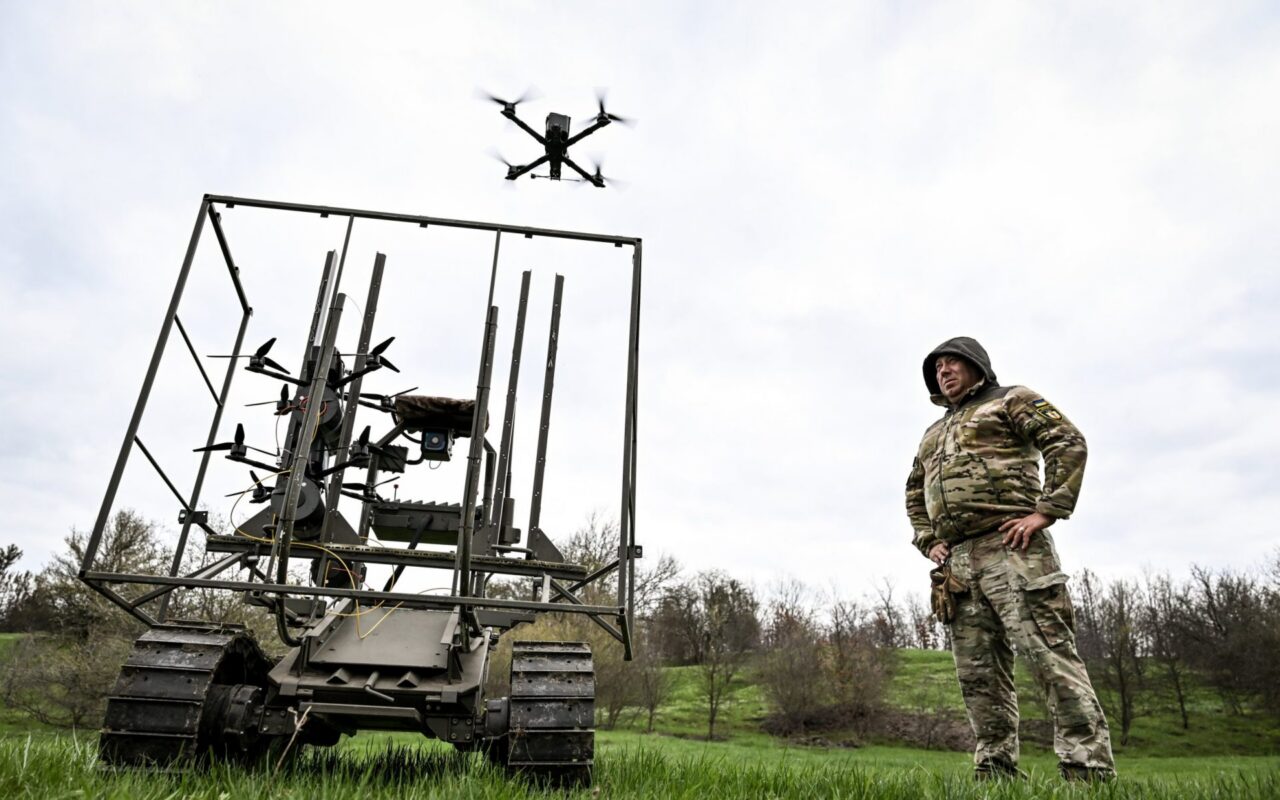
In the air, on the ground, and with new AI software, Ukraine is gaining an edge in technology that is helping to turn the tide of the war as Russian offensives stall.
On battlefields dominated by drones, Kyiv’s airborne systems are getting smarter, faster and cheaper, according to experts, while its robotic ground forces are storming positions and saving lives and equipment.
Meanwhile, the integration of AI has driven progress in guidance, target identification and jam-proofing, with Starlink connections keeping pilots in control of their weapons.
Kateryna Stepanenko of the Cognitive Warfare Project at the Institute for the Study of War, told The i Paper: “Ukraine is leading the way in revolutionising drone warfare because it combines both combat experience and rapid need for battlefield innovation, backed by very solid software.”
Those advances are giving Ukrainian forces advantages in multiple arenas of the battlefield.
Ground attacks with no soldiers present
Kyiv made history last month when it claimed the capture of a Russian frontline position using only robotic systems, with no human soldiers placed in the line of fire.
Russian soldiers surrendered to a force made up of unmanned ground vehicles (UGVs), Ukrainian President Volodymyr Zelensky said at the time. Ukraine has previously published footage of Russian servicemen surrendering to aerial drones.
Zelensky said UGVs carried out more than 22,000 missions on the front lines in the first three months of 2026, with the figure climbing rapidly each month.
Last year, Ukrainian manufacturers delivered 15,000 UGVs to frontline units, up from 2,000 in 2024. The country’s defence ministry is aiming to produce 25,000 in the first half of 2026, with the vast majority of those being used by Ukrainian forces made domestically.

Ukraine’s systems can be directed by a remote human operator, or can carry out missions autonomously using onboard sensors, navigation systems and computers. Crucially, given its ongoing manpower shortages, the UGVs can operate inside the “kill zone” – the 20km (12.4-mile) stretch surrounding the front line.
Robert Tollast, a research fellow in land warfare at the Royal United Services Institute, said ground robots could become as numerous as airborne systems. “If the trend line continues, it might resemble the nearly exponential aerial drone adoption,” he said, adding that the machines protect vital equipment as well as human lives.
“This war has consumed equipment at a rate that is hard to comprehend unless you track it,” he said. “Ukraine and Russia, each, have lost somewhere in the region of 5,000-6,000 vehicles that could be used to supply troops near the front line. That’s not even including dedicated fighting vehicles.”

Creating the perfect swarm
The drone war in the air has also seen rapid evolution as both sides adapt in response to the other’s innovations, while scaling up production to build mass and cut costs. This month, Ukrainian defence firm General Cherry rolled out a design for a mid-range strike drone, capable of reaching targets beyond the front such as missile complexes, electronic warfare systems, warehouses and enemy headquarters.
The Khmarynka, which translates as ‘Little Cloud’, is modelled on Russia’s Molniya drone, an ultra-cheap, lightweight kamikaze weapon made from plywood and plastic foam.
Ukraine’s version is intended for low-cost mass production that would allow commanders to launch swarms capable of overwhelming enemy defences. It exceeds the speed, range and payload of previous Ukrainian equivalents, with enough firepower to take out hardened targets such as infantry bunkers and armoured vehicles.

The Centre for European Policy Analysis think-tank said that aerial drones are now being used against up to 85 per cent of frontline targets, as well as serving other functions such as reconnaissance, guidance, logistics, air defence and electronic warfare.
Mike Armstrong, managing director of drone manufacturing company Stark UK, told The i Paper: “Ukraine has pushed drones from the margins to the centre of modern warfare… The battlefield is evolving so quickly that traditional procurement and development cycles can’t keep up, driving a shift towards systems that can be produced in volume and updated in real time.”
That expertise is much in demand. Kyiv recently signed deals with Saudi Arabia, Qatar, and the United Arab Emirates that included training, software and military equipment after they came under heavy drone and missile fire from Iran.
One of Ukraine’s top priorities is scaling up production of interceptor drones, which it claims to be using to destroy tens of thousands of Russian attack drones every month, at minimal cost. Many of these kills are credited to the P1-SUN interceptor from domestic defence firm SkyFall, a lightweight 3D-printed design with a top speed of 186mph and a range of more than 20 miles.

Each drone costs around £750, according to its producers, and can be used against the £37,000 Shahed drones deployed by Russia and Iran to devastating effect.
AI ‘headhunters’
The AI revolution is also playing a major role on the battlefield, and Ukraine may be claiming an early edge with the technology. The Ukrainian military uses AI to develop flight paths, map positions and recognise targets, while its Sky Map system uses machine learning alongside sensors to detect incoming air attacks.
Ukraine’s Delta battlefield management system uses AI inputs for the detection and classification of enemy vehicles and equipment, and synthesising intelligence for military forces in the field. “Ukraine is also implementing these innovations at [low] cost and reshaping force structures,” said Stepanenko.
Kyiv is also benefiting from the use of Elon Musk’s Starlink system, which allows drone pilots to maintain close control of their weapons and guide them to their targets, while avoiding enemy radar and jamming. Russia has been largely cut off from the system.

Earlier this month, Zelensky met with Alex Karp, CEO of data analytics giant Palantir, to discuss potential collaborations, with priorities said to include the use of AI to track the impacts of air strikes.
Ukraine’s defence minister, Mykhailo Fedorov, has said he is working with dozens of companies that are developing machine learning to better enable Ukraine’s military to identify and intercept aerial targets.
Meanwhile, Russian military bloggers have claimed that Ukraine is using AI-powered drones with facial recognition software as “headhunters” to take out soldiers in the field. This has not been confirmed.
Marina Miron, of the War Studies Department at King’s College London, said that one of the main military functions of AI right now is working through the vast amounts of data generated by drones. “Someone needs to process the exponentially increasing amounts of data from all the sensors,” she said.
“This is a battle for obtaining information and processing it fast enough to take decisions before your enemy does, and that’s where AI is key,” she added.
المصدر: iNews