My no-fly trip to modern Italy’s birthplace for coffee, aperitivo… and witchcraft
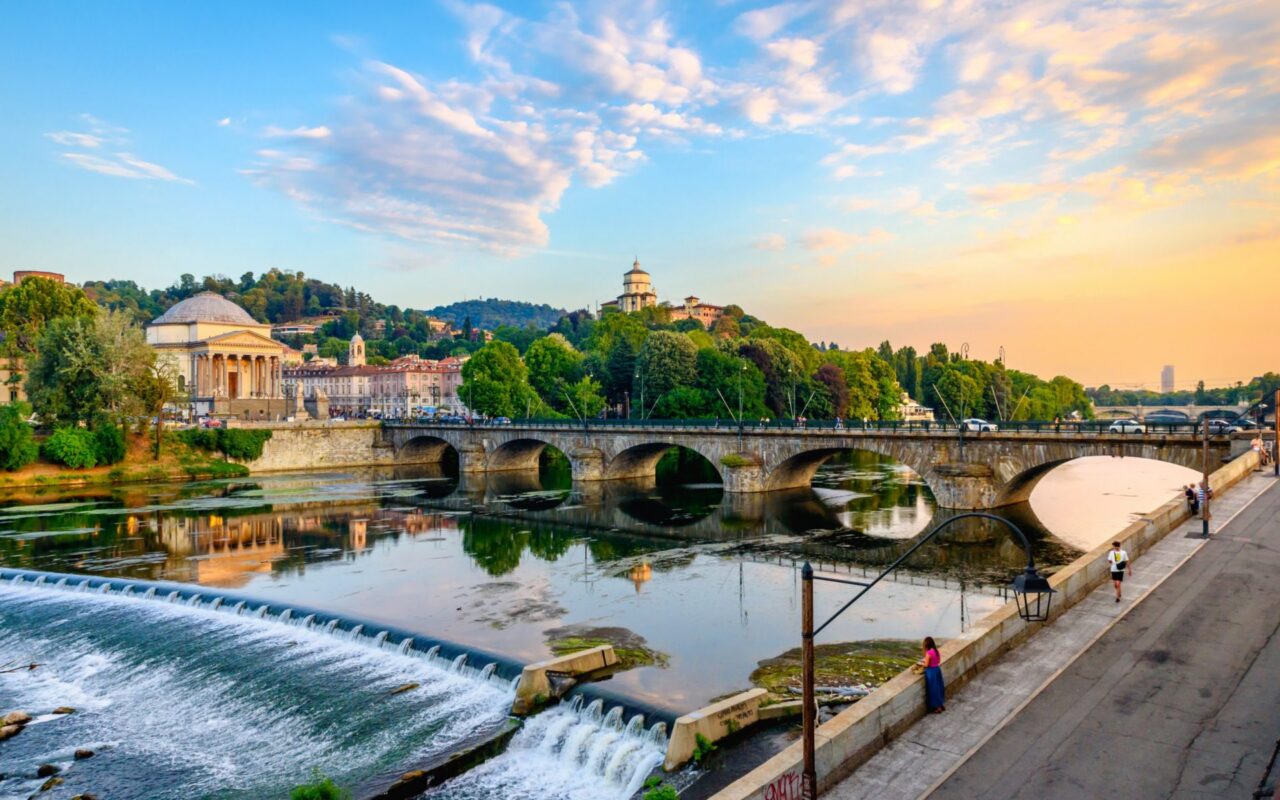
Outside, Turin is bathed in sunshine, tantalising glimpses of the white-tipped Alps visible through its streets. The former seat of the Duchy of Savoy, the city was the birthplace of modern Italy – it served as the country’s first capital from 1861-1865.
Surrounded by mountains and Piedmontese vineyards, it attracts visitors for its baroque architecture, Holy Shroud, Fiat and Lavazza heritage and aperitivo.
But instead, I am in the dimly lit basement of an elegant home, gazing at a rare 17th-century “Book of the Devil”. The grimoire, or spellbook, once used to summon powerful forces, is, I am told, covered in human skin. It is enclosed in a protective glass case – for its benefit or ours, I briefly wonder?
“The case periodically blackens,” says Norak Odal, director of Turin’s Museum of Contemporary Witchcraft.
“The book doesn’t like to be behind glass,” adds Daniela Surleti, the museum’s curator, as I take a step back.

The esotericists (Norak is a runic expert and Daniela is descended from the Masche, traditional Piedmontese witches) tell me Turin sits on the 45th parallel, midway between the North Pole and qquator. This latitude, a symbolic intersection of opposites, has given rise to the notion that the city lies at the centre of mystical black and white magic triangles.
Fittingly, the museum is a feast of arcana, full of curious ritual items. I view divinatory tools, amulets, herbal medicine, mummified animals. I am mesmerised. But Turin’s reputation as the occult capital of Italy is etched in its streets too, via landmarks, symbols, and hidden history.
I join a twilight tour with local operator Somewhere. “We are in the city’s dark heart,” explains my guide, Donatella Ferraris, as we stand in west Turin’s Piazza Statuto, gazing up at the 19th-century Fréjus Fountain. Ostensibly built to commemorate the completion of the Fréjus Railway Tunnel – which connects Italy to France through the Alps (making high-speed rail trips via Paris like mine a breeze) – the pyramid of rocks draped with tired-looking Titans is topped by an angel crowned with a pentacle.
“It is Lucifer, the fallen angel,” Donatella says. “He is stopping the Titans from reaching the peak of knowledge.” Others call it “The Winged Genius”, a bringer of light, not darkness. Turin’s orphic
secrets are, it seems, rather mutable.
The square lies over what was once a necropolis, cementing the area’s shadowy reputation. More menacing, on the nearby Via XX Settembre, is the imposing Portone Del Diavolo (The Devil’s Door). The intricately carved wooden door, built in 1675, currently fronts a bank.

“Look closely,” says Donatella, shining a torch on the door knocker: it features two coiled snakes emerging from the Satan’s mouth. “According to legend, a ballerina named Emma Cochet was stabbed to death in the building. No weapon was found, and after office hours, her ghost can be felt.”
In contrast, the Piazza Castello, by day packed with tourists, is a hotbed of “white” magic. The Holy Shroud, currently under wraps in a coffin-like case, is nearby in Turin Cathedral. “The aura of the shroud and the energy of people praying creates a feeling of light,” says my guide.
I am more interested in the alchemical caves rumoured to lie beneath the piazza’s Palazzo Madama, now full of imperial art treasures and part of the Musei Reali (Royal Museums) complex. “Alchemy was of great interest to Turin’s former Savoy rulers, and many philosophers and alchemists – among them Nostradamus and Nietzsche – have spent time in the city,” Donatella tells me.
One tale has it that the Philosopher’s Stone is hidden in the caves, and that you’ll find an entrance to them if you walk three times round the Fountain of the Tritons in the Royal Gardens.
I spend the next day zig-zagging across town. I pick up clementines from Porta Palazzo, Europe’s largest open-air market, and eat them in the glorious, leafy Parco Del Valentino. It hugs the banks of the River Po, which flows through the heart of the city. (In myth, Phaeton, son of Helios, crashed his chariot in the Po).

After ravioli and Piedmontese wine at Le Vitel Etonné, I try a bicerin, the city’s signature drink of layered chocolate, coffee and cream, in Caffè Al Bicerin, where it was invented. The café faces La Consolata, a church said to be a site of miracles bestowed by the Virgin Mary.
On my last day, I brave the crowds at the Museo Egizio, devoted solely to ancient Egyptian culture. Curator Martina Terzoli is eager to show me The Book of the Dead of Kha, so we peer at a papyrus roll inscribed with inky hieroglyphs.
“These are spells that offered guidance and protection on the afterlife journey,” she says. The detail is extraordinary. Further on, I am shown a collection of amulets, some dating back to a mind-boggling 722-332 BC. “It’s symbolic of stability and resurrection.”
Reeling in awe, I head for a vermouth at Caffè Elena on Piazza Vittorio Veneto, and toast this city of singular wonders.
How to get there
The writer was a guest of the flight-free travel firm Byway, which offers return rail travel from London to Turin via Paris, and a five-night B&B stay at the four-star Hotel dei Pittori, from £661pp (byway.travel).
How to visit
A 45-minute guided tour of the Museum of Contemporary Witchcraft costs €15pp (£13). Somewhere’s Magic Turin tour costs €45pp (£39). Entry to Museo Egizio is €18pp (£15.60).
More information
المصدر: iNews