Argentina’s Milei courts investment through key deregulation legislation

Buenos Aires, Argentina – In the past weeks Argentina’s Congress has advanced two major structural reforms promoted by President Javier Milei that could reshape the country’s regulatory framework and reignite debate over labor rights, environmental protections and investment rules.
The first measure, a major labor reform approved by both chambers, aims to make hiring more flexible by reducing litigation risks and introducing new severance fund schemes. The second proposal, currently under debate in the Chamber of Deputies, seeks to narrow the scope of Argentina’s glacier protection law, a change that could allow mining activity in areas previously restricted in the Andes.
The laws are part of a broader strategy by the libertarian government to deliver on campaign promises of attracting foreign investment and boosting economic activity after years of stagnation.
But both initiatives have drawn strong criticism from labor unions, environmental organizations and opposition lawmakers, who argue the reforms could weaken worker protections and environmental safeguards.
Labor reform targets hiring costs and litigation
In late February, lawmakers approved a sweeping labor reform aimed at making hiring more flexible and reducing litigation risks for companies — a controversial issue that led to a nationwide general strike and widespread protests outside Congress.
Approved by both chambers and now entering the implementation phase, the labor reform introduces several changes to Argentina’s employment framework, including the creation of severance funds that allow companies to replace traditional dismissal compensation with a capitalized system funded during employment.
The legislation also extends probationary periods for new hires and reduces penalties for companies that previously failed to properly register workers — a measure the government says could encourage formal employment in a country where nearly half of 12.9 million workers operate in the informal economy, according to the latest figures from Argentina’s national statistics agency (INDEC).
Other provisions expand the list of sectors considered “essential services,” placing limits on strike actions in areas such as transportation, energy and health. For the Milei administration, the reform aims to address structural barriers that have discouraged companies from hiring workers.
“Labor modernization has as its primary benefit the creation of employment,” Labor Secretary Julio Cordero said while defending the initiative during the congressional debate. According to Cordero, the reform seeks to correct distortions that have accumulated in Argentina’s labor system over time while preserving “essential worker protections.”
President Javier Milei celebrated the vote shortly after its approval, calling the measure “historic” and presenting it as a key step in modernizing Argentina’s labor market.
Supporters argue Argentina’s labor regulations have long discouraged job creation due to legal uncertainty and high non-salary labor costs. During the Senate debate, Senator Patricia Bullrich defended the reform arguing that Argentina has developed what she described as a “trial industry,” referring to the high level of labor litigation that, according to supporters of the bill, discourages companies from hiring.
“These measures move in the direction of creating a more favorable reputation for business, trade and investment,” stated Marcelo Elizondo, an economist specializing in international trade, to Argentina Reports.
“The labor law makes hiring more agile. One of Argentina’s main problems in job creation has been the uncertainty surrounding the labor regime and the high non-salary labor costs, which this reform significantly reduces,” he added.
According to Elizondo, the reform is part of a broader deregulatory strategy that began with Milei’s sweeping economic decree in late 2023 and continued with legislative initiatives aimed at improving the country’s business climate.
Glacier law reform reopens debate over mining
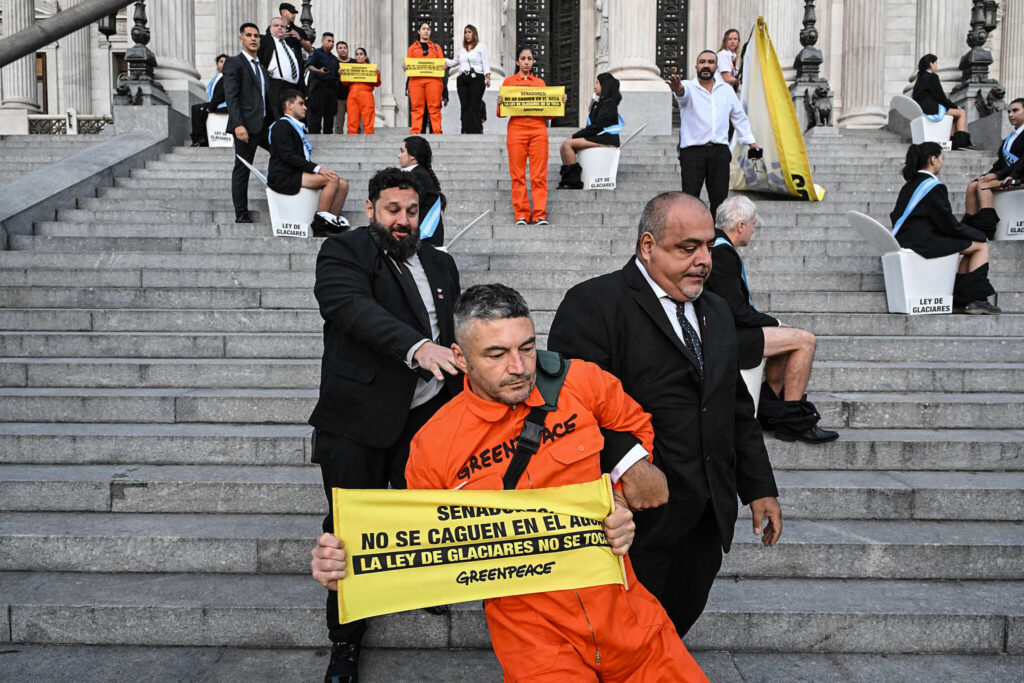
Just days after passing Milei’s labor reforms, the Senate also gave initial approval to changes to Argentina’s glacier protection law, a move critics say could reopen previously restricted areas to mining activity in the Andes. The bill is now under debate in the Chamber of Deputies, where the final vote has been extended into the first week of April.
The proposed reform seeks to redefine which glaciers qualify for legal protection, limiting safeguards to those that demonstrate a verified hydrological function.
Supporters say the measure could reduce regulatory uncertainty and allow mining projects to move forward in areas previously restricted under broader definitions of periglacial zones.
The debate is particularly relevant for Argentina’s mining sector, as the country forms part of the so-called “lithium triangle” alongside Chile and Bolivia and holds some of the world’s largest reserves of lithium — a key mineral used in electric vehicle batteries.
Economist Martín Kalos of the University of Buenos Aires said the reform touches on a longstanding debate within the mining sector over regulatory ambiguity. “There has been uncertainty about what constitutes a periglacial area and whether a mining project could later be challenged under glacier protection rules,” he told Argentina Reports.
However, Kalos warned that the reform may not necessarily eliminate legal risks for investors. Argentina, he explained, is a signatory to the Escazú Agreement, which incorporates the principle of environmental non-regression — a doctrine that could expose the new law to constitutional challenges if courts determine that environmental protections have been weakened.
“The risk of judicialization remains,” Kalos said, noting that environmental disputes in Argentina can take years to resolve and that uncertainty therefore remains.
The political consensus question
Beyond the environmental debate, analysts say Argentina’s broader challenge lies in building political consensus around structural reforms. Large investment projects — particularly in sectors such as mining, energy and infrastructure — often require regulatory stability that extends beyond a single administration, which can be challenging in a country that has shifted between political parties in the past three presidential elections.
In that sense, Kalos pointed out that the lack of broad political agreement could raise questions for investors evaluating long-term projects in the country. “Argentina changed its glacier law after only 15 years,” Kalos said. “If reforms do not achieve broader political consensus, investors may wonder whether they could be reversed by a future government.”
That concern has also appeared in Argentina’s negotiations with the International Monetary Fund (IMF), which has repeatedly emphasized the importance of political support and institutional stability to sustain economic reforms over time.
On the other hand, opposition lawmakers have strongly criticized the initiatives. Peronist Senator José Mayans described the labor reform as “an unconstitutional embarrassment” and argued it “weakens workers’ rights” while “favoring employers”.
Environmental groups have also raised concerns about the glacier law changes, warning that loosening protections could open fragile ecosystems in the Andes to mining activity.
For Kalos, the broader issue goes beyond the specific reforms. “Argentina has not had a broad debate about its long-term development model,” he said. “Without that consensus, reforms can become part of the country’s political pendulum.”
Investment opportunities — and uncertainty
Despite the controversy surrounding the reforms, both analysts agree that Argentina continues to offer significant opportunities for foreign investment in sectors such as energy, mining, agribusiness and services linked to those industries.
Large-scale projects in shale oil and gas development, lithium extraction and agro-industrial value chains remain attractive to international investors seeking exposure to natural resources and emerging markets.
The challenge for Milei’s government will be whether its reform agenda can create the stable regulatory environment needed for those investments to materialize.
For supporters, the reforms signal a country attempting to reposition itself in global markets. For critics, they raise a deeper question that has long defined Argentina’s economic trajectory: whether structural reforms can endure beyond the country’s volatile political cycles.
Featured image description: President Javier Milei.
Featured image credit: Javier Milei via Instagram.
The post Argentina’s Milei courts investment through key deregulation legislation appeared first on Argentina Reports.
المصدر: Argentina Reports