Can We Ever Fix Bengal’s Violent Political Culture?
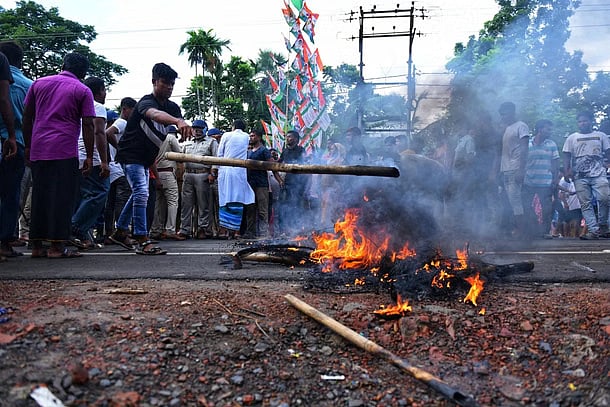
Landmine of Social Tension and History
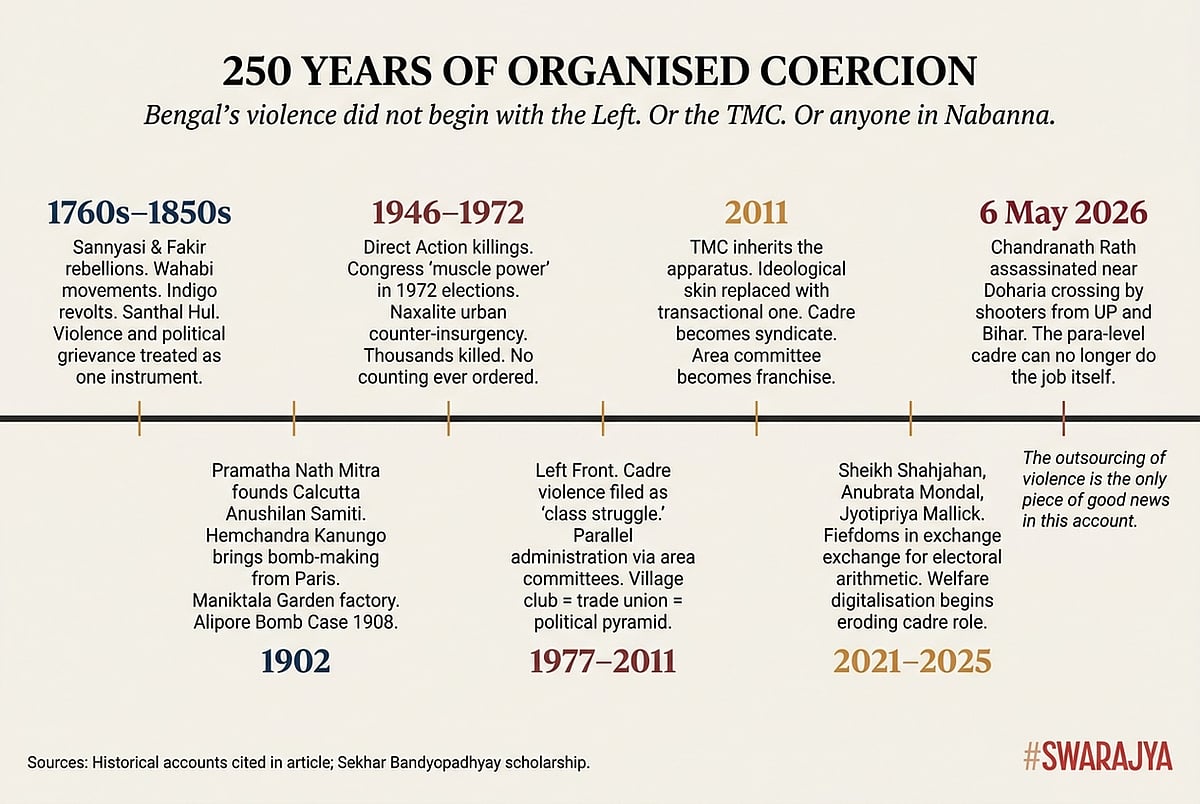
On the night of 6 May 2026, a suspected sharpshooter from Ballia in Uttar Pradesh and two associates from Buxar in Bihar waited near the Doharia crossing in Madhyamgram, West Bengal, to assassinate Chandranath Rath.
Rath was Suvendu Adhikari’s closest personal aide during his opposition years, the kind of man who knew which phones to answer and which to ignore, which dinners to confirm and which to lose in transit.
‘Dada has requested you all to stay calm and not indulge in any violence,’ he had told the local cadre that afternoon. He was shot dead a few hours later.
This has been the situation so long in Bengal that the institutions meant to address it have long since accommodated themselves to its existence.
Below the excuse of ‘political violence’, sits a huge landmine of social tension, historical continuity and friction.
Perilous Record Of Violence
In one of his interviews, Pratim Ranjan Bose, a senior journalist and long-term observer of Bengal’s society and politics, said that in 2024, by official compilation, 64 per cent of all violence reported nationally came out of West Bengal. The most recent NCRB data places West Bengal first in the country in acid attacks, accounting for 27.5 per cent of the national total.
NCRB 2023 figures also show that Bengal recorded 34,691 crimes against women, placing it among the four highest-reporting states in India after Uttar Pradesh, Maharashtra and Rajasthan. In attempted rape cases, the state stood second nationally with 825 reported incidents, just behind Rajasthan’s 845.
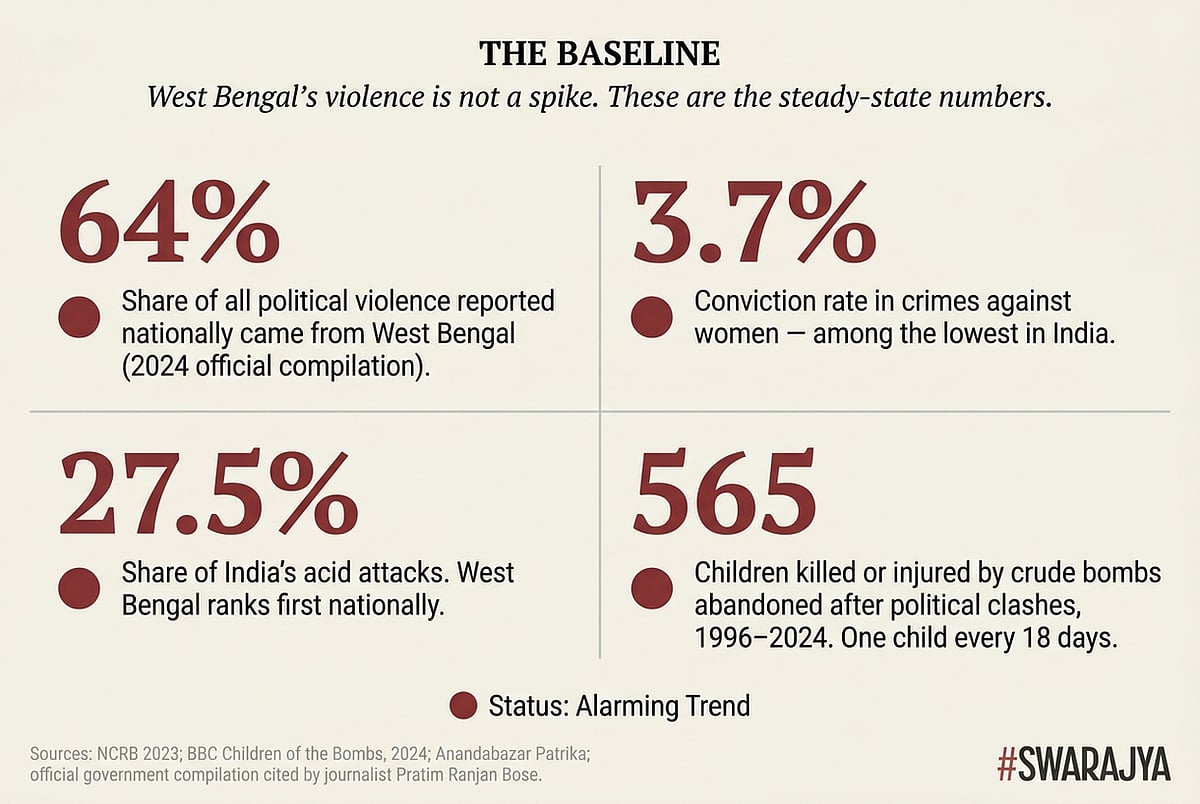
Judicial outcomes are more alarming. Bengal’s conviction rate in crimes against women stood at barely 3.7 per cent, among the lowest in the country, meaning acquittal remained the overwhelmingly dominant outcome once trials concluded.
Kolkata may still report relatively low rape numbers compared to other metros, but some of the country’s most shocking recent crimes against women emerged from Bengal itself, from the RG Kar rape-murder case and the gangrape of a law student to assaults inside hospitals, molestation cases in moving vehicles and repeated allegations of politically protected intimidation networks operating in the state’s urban and peri-urban spaces.
A 2024 BBC documentary, Children of the Bombs, drawing on reports published in Anandabazar Patrika and Bartaman Patrika, reported that between 1996 and 2024 at least 565 children in Bengal were killed or injured by crude bombs abandoned after political clashes. One child every 18 days. That is the difference between Bengal and the older clichés associated with UP and Bihar, which have also produced violence at scale. Neither has produced the casualty type that depends on the casual leaving-around of military-grade improvised explosives in village fields.
The crude bomb answers a specific operational requirement of cheap, deniable, locally manufacturable, and producible at scale by the same panchayat networks that run welfare delivery.
That is why Bengal’s violence is not a misgovernance story in the way Bihar’s once was. It is a structural condition India has accepted, election after election, for the better part of three generations.
Violent In Nature
The roots don’t fully lie with TMC or its predecessors INC and the Left parties. Bengal’s relationship with organised violence predates both Marxism and electoral politics.
The geography that the British carved out as the Bengal Presidency in 1765 had absorbed the highest density of armed political action of any Indian subah. The paik system of armed peasant retainers, common to Bengal and Odisha under late Mughal zamindari, produced a class of part-time soldiers attached to landowners whose primary occupation was the protection of revenue.
Violence in the Sannyasi and Fakir rebellions of the 1760s and 1770s, the Wahabi movements of the early nineteenth century, the Indigo revolts of 1859-60, the Santhal hul of 1855 in what was then Bengal Presidency indicates that for the average Bengali, political grievance and physical force were the same instrument under different names.
By the time the British anointed Calcutta the Second City of Empire, the countryside was a landscape in which violence had been theorised, ritualised, routinely deployed.
Calcutta itself industrialised the principle. The akhada clubs, originally wrestling pits attached to neighbourhood committees, evolved through the late nineteenth century into the founding cells of organised revolutionary politics.
Hemchandra Kanungo travelled to Paris in 1907 to apprentice under Russian revolutionaries, returning to set up the Maniktala Garden bomb factory. The Alipore Bomb Case of 1908, the Muzaffarpur killings were the founding curricula of modern-day violence.
Between 1947 and 1967, the state was governed by the INC. Through Bengali cinema and the nostalgia of an older bhadralok generation, Bengal of that era is a developmental state midwifing the steel plants of Durgapur, the chemicals industry of Haldia and the cultural renaissance of College Street.
Later, the 1972 assembly election, in which INC returned to power after brief opposition coalitions, is widely seen as having been delivered through what one period observer called sheer muscle power. Between 1968 and 1972, the Calcutta street was the site of the first sustained urban counter-insurgency in post-Independence history. Charu Majumdar’s Naxalite cadre were hunted down street by street, para by para, with a methodology that the CPI(M) would later inherit wholesale and refine.
The state police, the Eastern Frontier Rifles, and Congress-aligned street formations operated as a tripartite force with thousands of killings. The counting is still vague, because no Congress chief minister was ever asked by Delhi for one.
One episode from that transition period would later acquire near-mythic status in Bengal’s political memory. The Sain family killings in Burdwan in March 1970 came to symbolise the brutalisation of party conflict in the state’s semi-urban belt. Pranab Sain and his younger brother Malay, both associated with the Congress, were killed by alleged CPI(M) cadres in front of their mother, Mriganayani Devi. She was forced to consume rice mixed with her sons’ blood.
The 83 accused were named in Police Station Case No. 50 of 1970. Key names such as Benoy Konar, Anil Basu, Khokon alias Nirupam Sen, Manik Roy rose to become the most senior CPI(M) leaders in the state. Konar’s name passed into household recognition. Sen became the Industries Minister. The Congress government in office at the time of the killings did not prosecute. The Left Front government that followed had no incentive to.
Sainbari demonstrates how quickly violence in Bengal could move from ideological confrontation to social-political terror.
Few Indian states carried such a long political apprenticeship in organised coercion, or developed such an enduring social vocabulary to justify it. The violence was always dignified by some larger story being told above it.
Left’s Ideological Cleansing
What the Left Front contributed, after 1977, was the most thorough ideological laundering any party has ever attempted in Indian history. Cadre violence was elevated into a sociological category called class struggle. A parallel administration of area committees and local committees ran beneath the state’s official one.
The village club, the para office, and the trade union were absorbed into a single political pyramid.
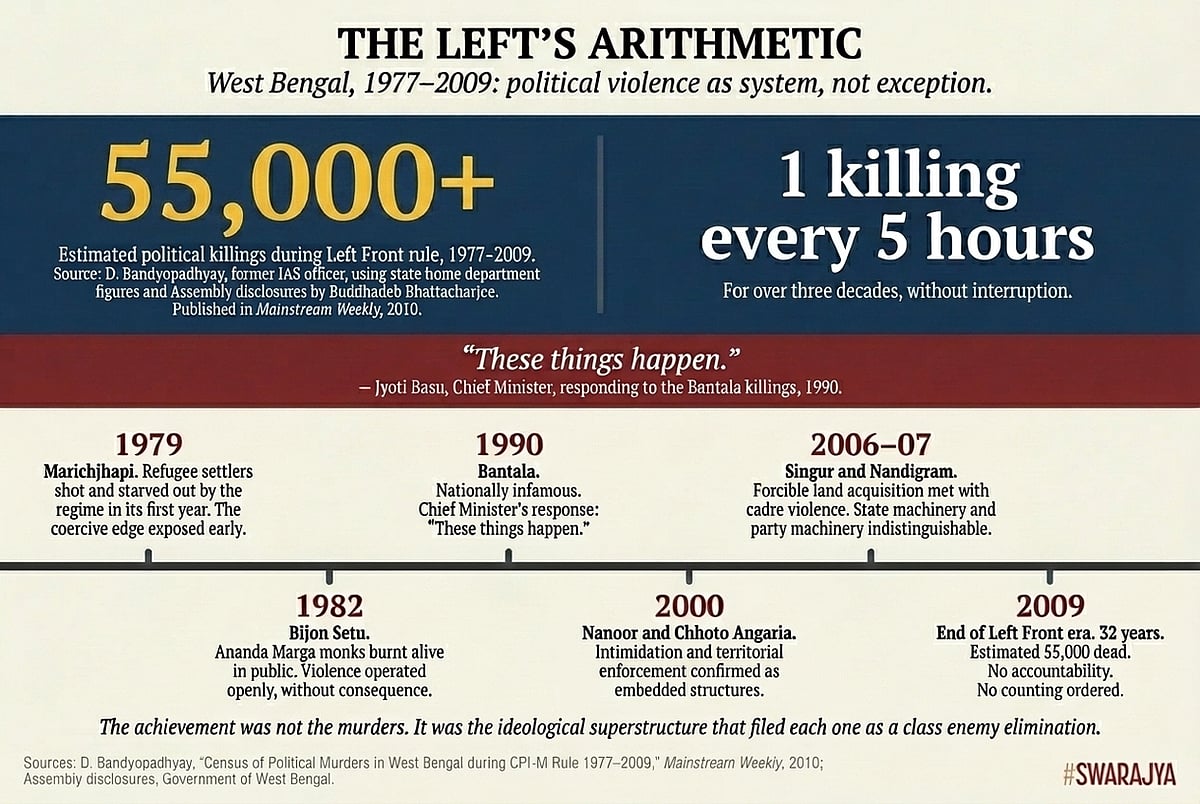
The Left Front’s real intellectual achievement in these years was the construction of an ideological superstructure that allowed every individual killing to be filed as a class enemy elimination or a counter-revolutionary casualty, while simultaneously persuading the country that Bengal under the CPI(M) represented the moral high ground of Indian democracy.
The same Calcutta University departments that produced Amartya Sen and Sukhamoy Chakravarty also produced the cohort of party-card-holding intellectuals whose function, for three decades, was the laundering of organisational violence into the language of dialectical materialism.
Trinamool inherited this apparatus in 2011. Mamata Banerjee replaced its ideological skin with a more transactional one. The cadre became the syndicate and the area committee turned into a franchise. Sheikh Shahjahan in Sandeshkhali, Anubrata Mondal in Birbhum, Jyotipriya Mallick in the PDS, each ran a fiefdom in exchange for delivering electoral arithmetic.
After sixty years, the instinct is to call this Bengal’s problem. It is the country’s longest-running tolerated experiment in subnational lawlessness. This environment has effectively rendered the state a no-go zone for any law enforcement machinery except the local police, who often operate as a partisan shield rather than a neutral force.
To read current violence as a consequence of socio-political phenomenon alone is to misread Bengal’s violence of today. Yes, it is true that Bengal’s culture is naturally agitated, in arguments or in arms. It is also true that its manifestations in the 2020s give us a ray of hope.
What Today’s Violence Looks Like
Today’s Bengal violence is defensive in nature. It is the violence of a shrinking economy, depleting reserves, static consumer expectations and the race to preserve whatever is left in the system with 24th rank on per capita income.
This is the consequence of the economy going haywire.
From accounting for 27 per cent of India’s industrial output at Independence, West Bengal today contributes 4 per cent. Its share in national GDP has fallen from 10.5 per cent in the early post-Independence decades to 5.6 per cent by 2023-24.
In 1960-61, Bengal ranked as India’s third-richest state by per capita income. By 2023-24, it had slipped to twenty-fourth, overtaken by states such as Karnataka, Telangana and Odisha which had once lagged far behind it. More details in this report here
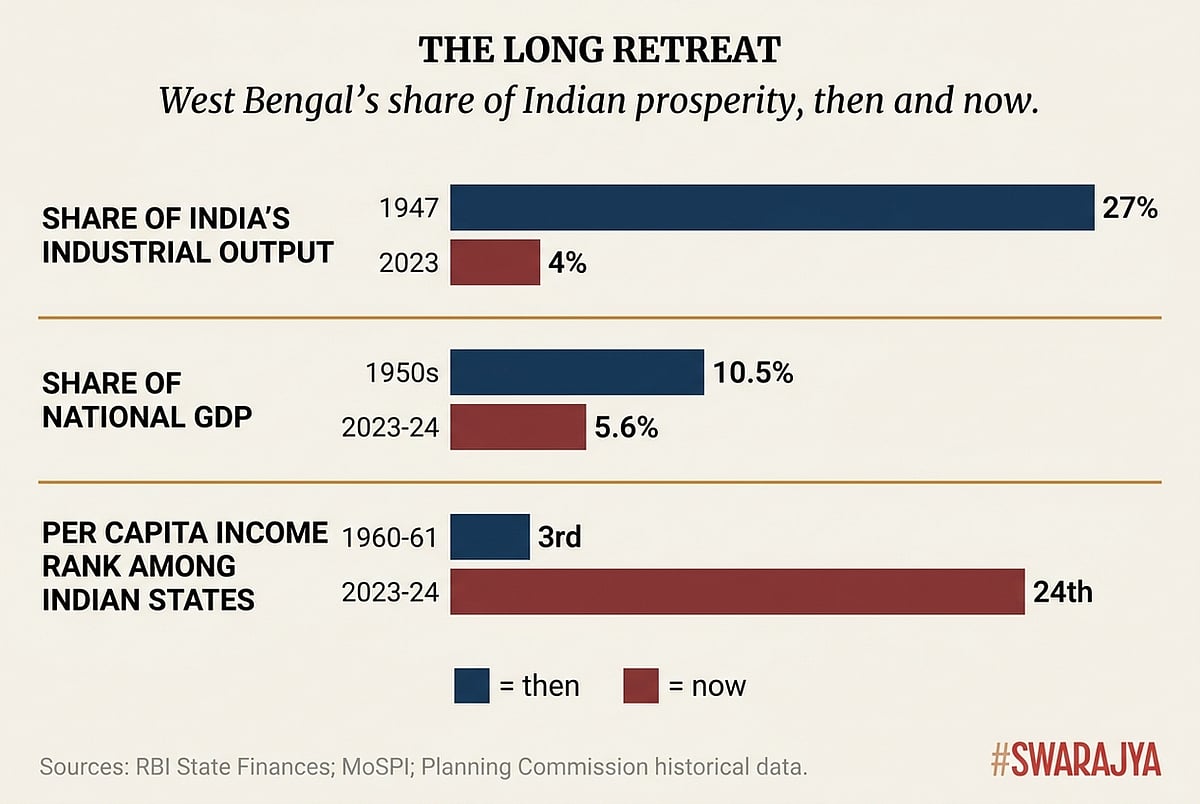
This problem is exacerbated by intra-state inequality. Kolkata’s estimated per capita income for 2024-25 stands at ₹3.55 lakh, more than three times that of Uttar Dinajpur at ₹1.06 lakh. Districts such as Murshidabad, Malda and Purulia remain clustered near the bottom at ₹1.3 to 1.4 lakh, while Kolkata, Darjeeling and the industrial belt of Paschim Bardhaman operate in an entirely different economic universe. West Bengal is essentially a Kolkata-centred service economy sitting atop a large low-productivity hinterland dependent on migration, subsidies and informal survival.
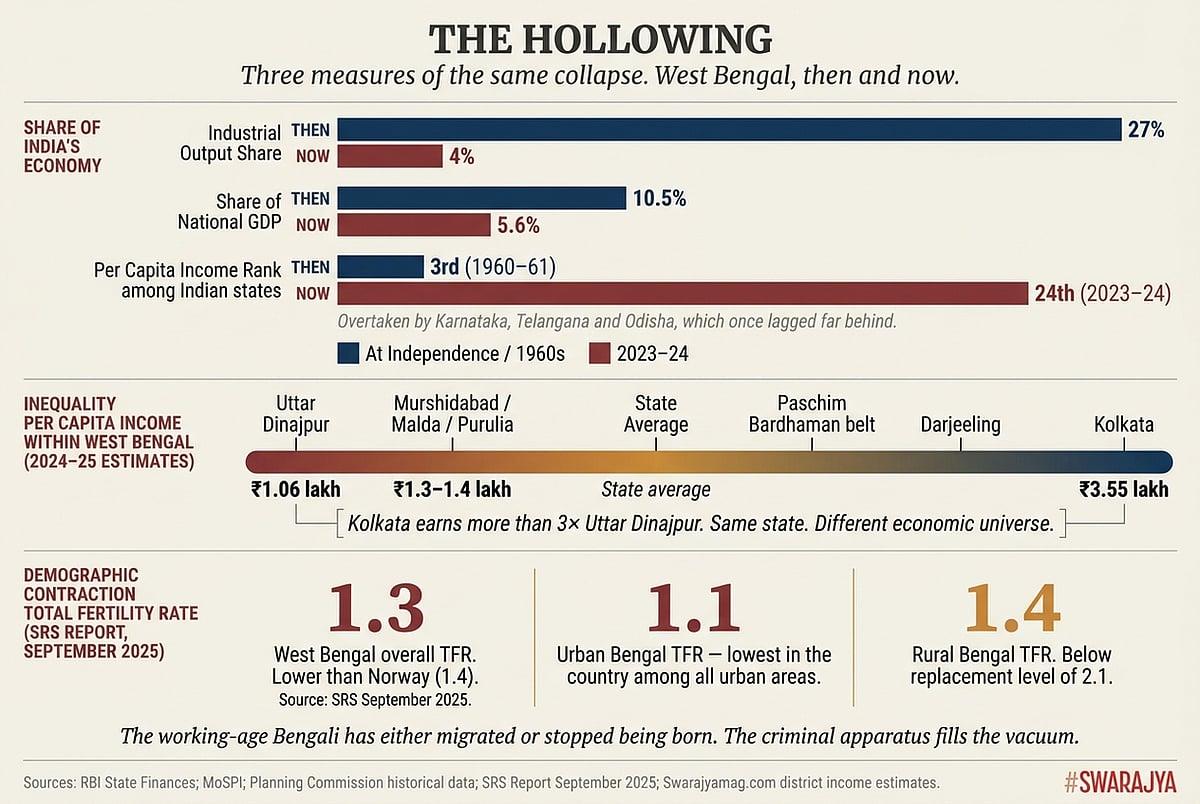
The deindustrialisation has produced exactly the demographic substrate under which the criminal apparatus becomes economically rational. According to the Sample Registration Survey (SRS) report of September 2025, the state’s total fertility rate is 1.3, lower than Norway’s. Its urban TFR at 1.1 is the lowest in the country, while the corresponding figure for rural Bengal is 1.4.
The working-age male in large stretches of rural Bengal has either migrated to Bengaluru, Hyderabad and Gurugram, sending remittances back, or stayed behind to draw a Lakshmir Bhandar equivalent, attach himself to a panchayat neta, and collect ten thousand rupees a month for being available when the party calls.
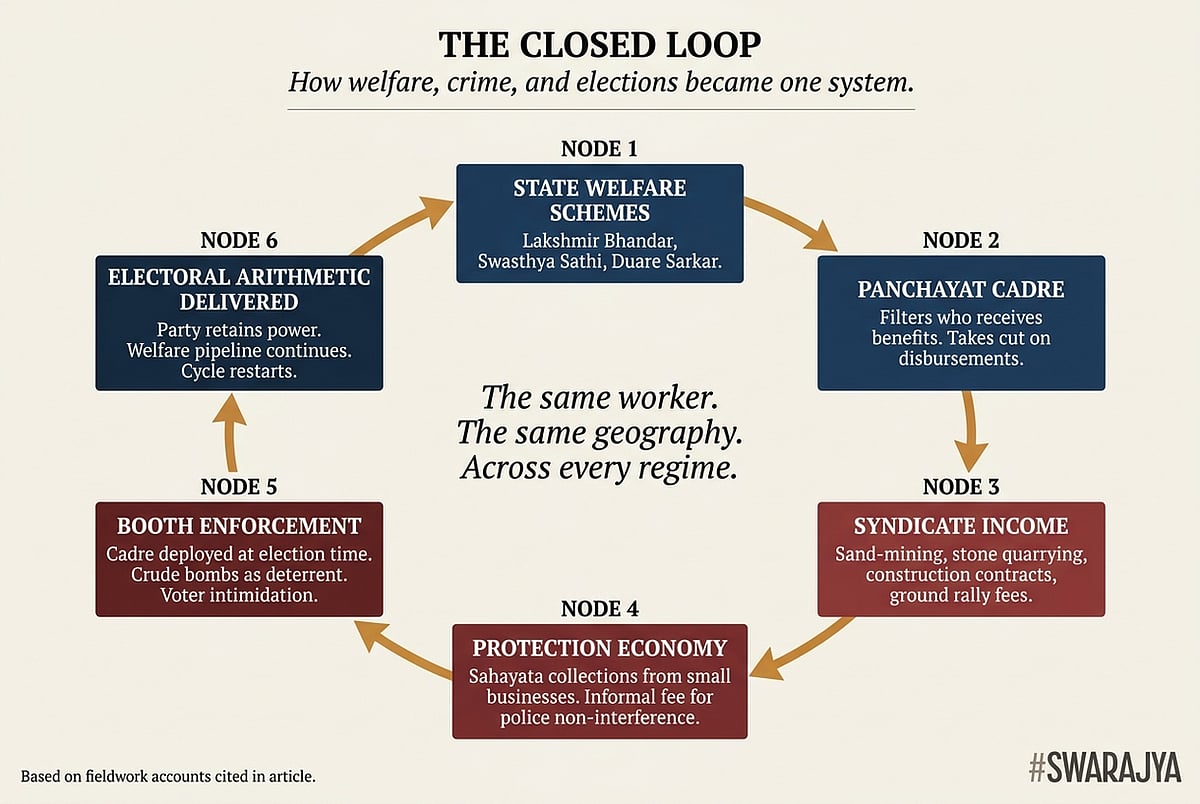
Sukumar Mondal, a panchayat-level functionary in Diamond Harbour who has worked through the CPI(M) and then the TMC, told a researcher in 2024 that the kaam had not changed across regimes. ‘Pehle Alimuddin se aata tha, ab Kalighat se aata hai. Kaam wahi hai. Padosi ko thanda karke rakho. Vote ka time pe sambhal lenge.‘ (Earlier the orders came from Alimuddin Street. Now they come from Kalighat. The work is the same. Keep the neighbour cold. Manage him when the vote comes.)
Skilled Bengalis have been leaving for two generations. The bhadralok who once exported clerks to the rest of India now exports waiters and security guards. The young man from Murshidabad lays bricks in Ernakulam and Bengaluru because at home, the politics of the para lets him refuse the same work for the same money.
India built its Bengaluru and Hyderabad and Gurugram through the same 40 years in which the state that had once been the country’s intellectual capital became one of the largest single exporters of unskilled, working-age men.
Three Types Of Invisible Bengalis
The substrate produces three recognisable types.
The first is the cadreperson like Sukumar Mondal, having no business or salary. His income comes from the cuts on welfare disbursements that pass through his hands, the syndicate share on sand-mining and stone-quarrying contracts in his block, the tola on small businesses in his ward, and the occasional five-figure pay-out for organising attendance at a Ground rally. His function is to filter access to the welfare state.
The second is the migrant. A prodigal son or daughter who grew up in a village near Burdwan and now works as a civil engineer in Hyderabad with seven figure annual income, approximately 20 per cent of which goes to parents. When asked by Hyderabadi colleagues about not returning, the answer is ‘Kaam nahi hai. Aur jo hai, woh party ke through milta hai.‘ (There is no work. And what work there is comes through the party.)
The third is the watcher, archetyped by a woman running a small embroidery business out of her one-room ground-floor unit in Howrah. She employs four women, all of them widows or abandoned wives. She does not pay protection money in the formal sense, but every month, on the second Tuesday, a young man comes to her unit and collects ₹2,000 in cash as sahayata, assistance.
Sahayata covers, in her understanding, the fact that the local police will not register an FIR against her if a customer disputes a payment, and that the local TMC ward office will not organise a sudden electricity-meter inspection that finds three violations. When asked, she does not describe Bengal as violent, but as jhamela, complicated, troublesome, requiring management.
The young man who collects the sahayata on the second Tuesday of every month is 23. He has a graduate degree in commerce from a local college. He applied for the West Bengal Civil Service in 2023 and did not clear the preliminary examination. He has a half-time job at a Vodafone retail outlet that pays him ₹9,000 a month. The sahayata collection, of which a fixed share passes to him, supplements that income by approximately ₹14,000 a month. He has traditionally voted for the most oft-spoken pre-election winner (TMC in his case).
The cadre, the migrant, and the watcher are the three operational types of Bengal’s deindustrialised demography. They are not the same though.
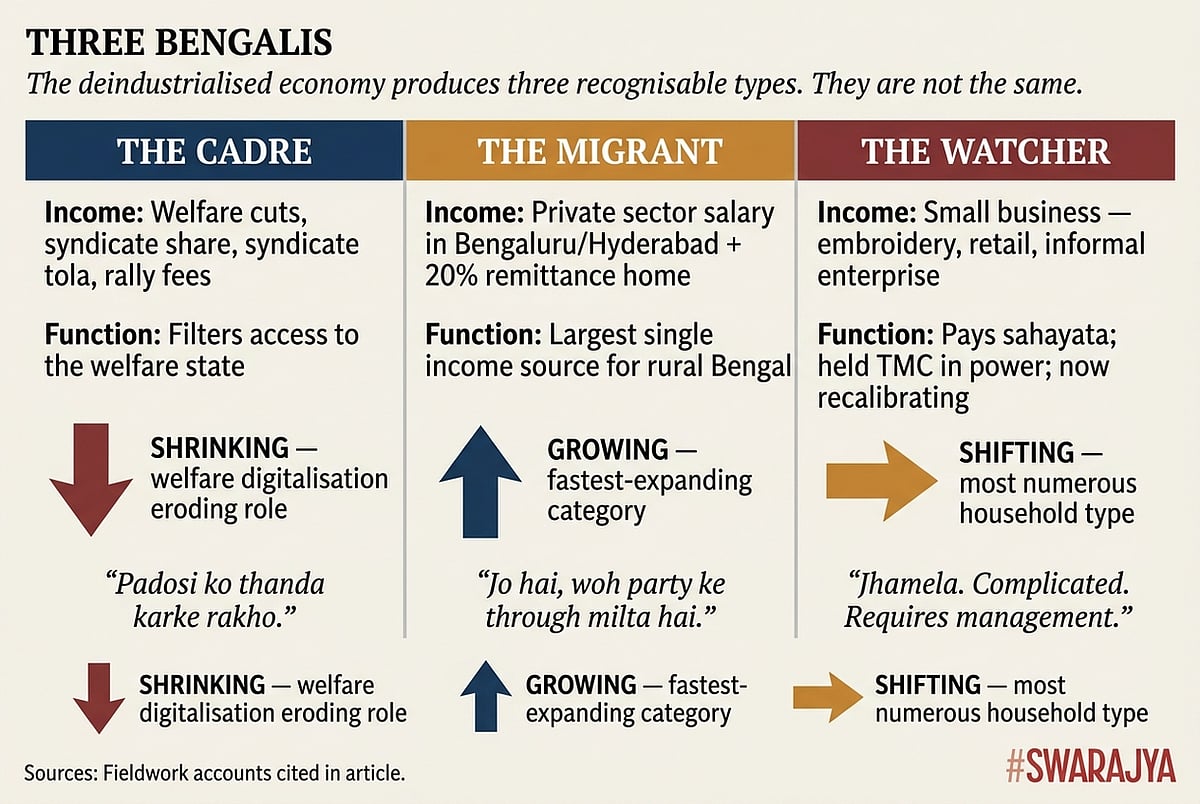
The cadre is shrinking in absolute numbers because welfare delivery has been substantially digitalised since 2020. The migrant is the fastest-growing category and is, in absolute remittance terms, the largest single income source for rural Bengal. The watcher is the most numerous category by household, and is the demographic that has held the TMC in office for 15 years and is now, under the BJP, looking to quietly recalibrate.
Politics And Employment
Recalibration is required because politics is the only domain which provides guarantee of employment from the comfort of hometown. When that is the structure, every booth is a workplace, every club a labour pool, every regime change a redundancy notice. The same workers shift across party flags overnight because the income survives even when the ideology changes.
The cadre that built the Left, that switched to the Trinamool after 2011, that the BJP now courts and holds at arm’s length, is the same cadre.
Viewed from this standpoint, current violence is an instrument of preservation. Sukumar Mondal does not deploy crude bombs to gain new territory. He deploys them, or threatens to, to hold what his predecessors under the Left Front already held, against an economy that is steadily shrinking around him. The bomb is a defensive instrument at the level of the para.
None of this takes away the bad faith on his part to harm others in lieu of his own profiteering motives. The argument here is that a polity with a deindustrialising economy would bring out the worst of humanity, which by definition is a mixture of both good and bad.
The Two Templates Next Door
Bengal’s problem is not unprecedented. Two other states, Uttar Pradesh and Bihar, have been there and done that.
When Nitish Kumar took office in November 2005, Bihar’s per capita income stood at ₹7,914, government offices ran on Remington typewriters, and the police filled barely 30 per cent of sanctioned posts. He summoned Abhayanand, then Additional Director General of Police, and asked whether Jungle Raj could be ended. Abhayanand’s answer was yes, on condition that policing remained within the ambit of law.
The instrument he built, the Speedy Trial framework, produced 9,768 convictions in its first fifteen months. In 2010 alone, the district judiciary convicted 14,311 persons in speedy trials, of whom 37 received the death penalty and 1,875 life imprisonment. By 2012, cumulative convictions crossed 60,000.
Pappu Yadav and Mohammad Shahabuddin went to prison under the framework that had earlier been written off as cosmetic. The Bihar Police Act of 2007 then separated investigation from law-and-order at the thana level, removing the instrument through which bahubali MLAs had historically held the local police hostage. As an indirect consequence, Bihar’s GSDP grew at 11 per cent annually between 2004-05 and 2008-09, second-fastest in India after Gujarat.
Uttar Pradesh ran the second experiment. UP DGP’s December 2025 briefing recorded 16,284 police operations, 10,990 alleged criminals injured, 266 killed in encounters, action under the Gangsters Act against more than 45,000 persons, and property attached under various extortion and gang Acts crossing ₹20,000 crore under Yogi Adityanath since 2017.
The Mukhtar Ansari, Atiq Ahmed and older Yadav-Singh networks of Purvanchal were dismantled. The Global Investors Summit of 2023 produced commitments crossing ₹35 lakh crore. Booth-capture, the signature instrument of UP elections through three preceding decades, has completely collapsed.
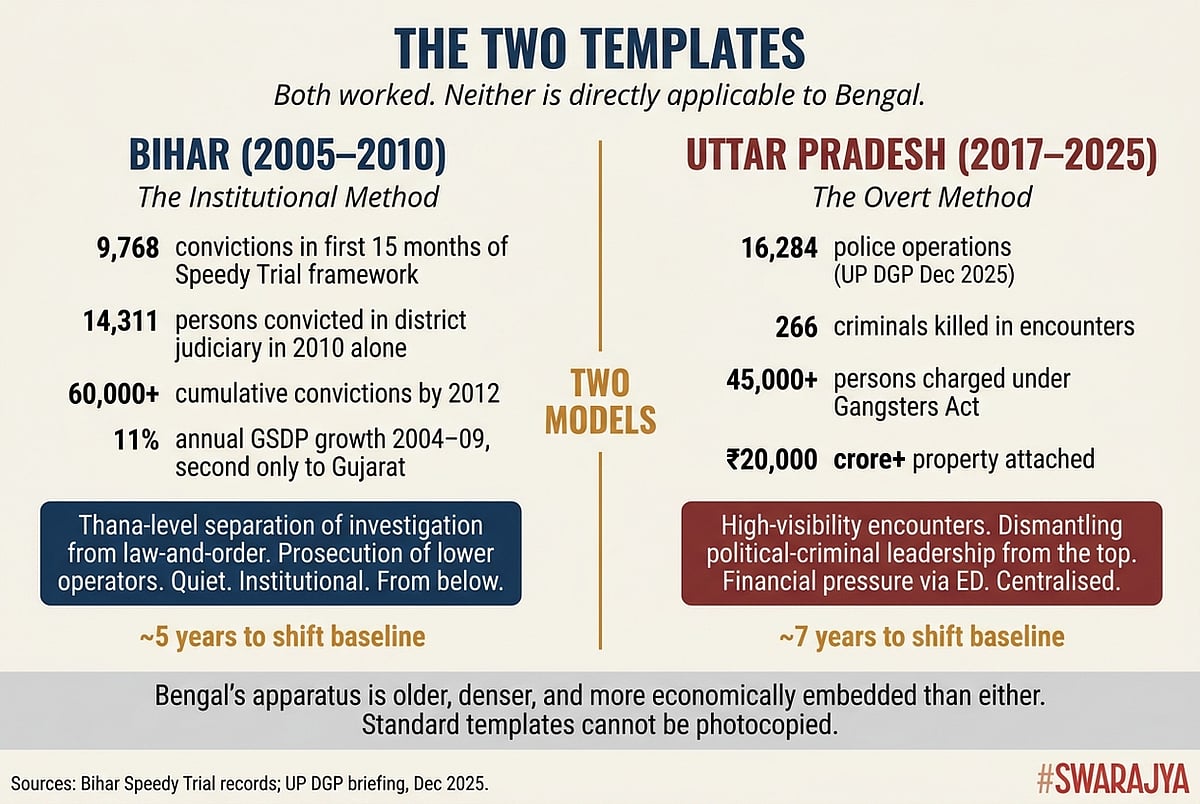
The two models attacked the apparatus from opposite ends.
In Uttar Pradesh, the strategy was overt and centralised. High-visibility encounters, the dismantling of political-criminal leadership, property attachment and ED pressure were used to break the patronage structure from the top downward.
In Bihar, the method was quieter and institutional. Speedy trials, administrative separation at the thana level and sustained prosecution of lower-level operators slowly hollowed out the enforcement base on which the political structure depended. Yogi Adityanath altered the baseline in roughly seven years. Nitish Kumar did it in about five.
Bengal’s apparatus is older, socially denser and economically more embedded than the systems Bihar and Uttar Pradesh confronted at the moment of intervention. In Bihar, the criminal structure had already begun to detach itself from everyday social life by the mid-2000s. In Uttar Pradesh, the syndicate economy still sat atop an expanding economic base.
Bengal is different because the apparatus and the local economy have fused into each other after decades of deindustrialisation and political mediation of work.
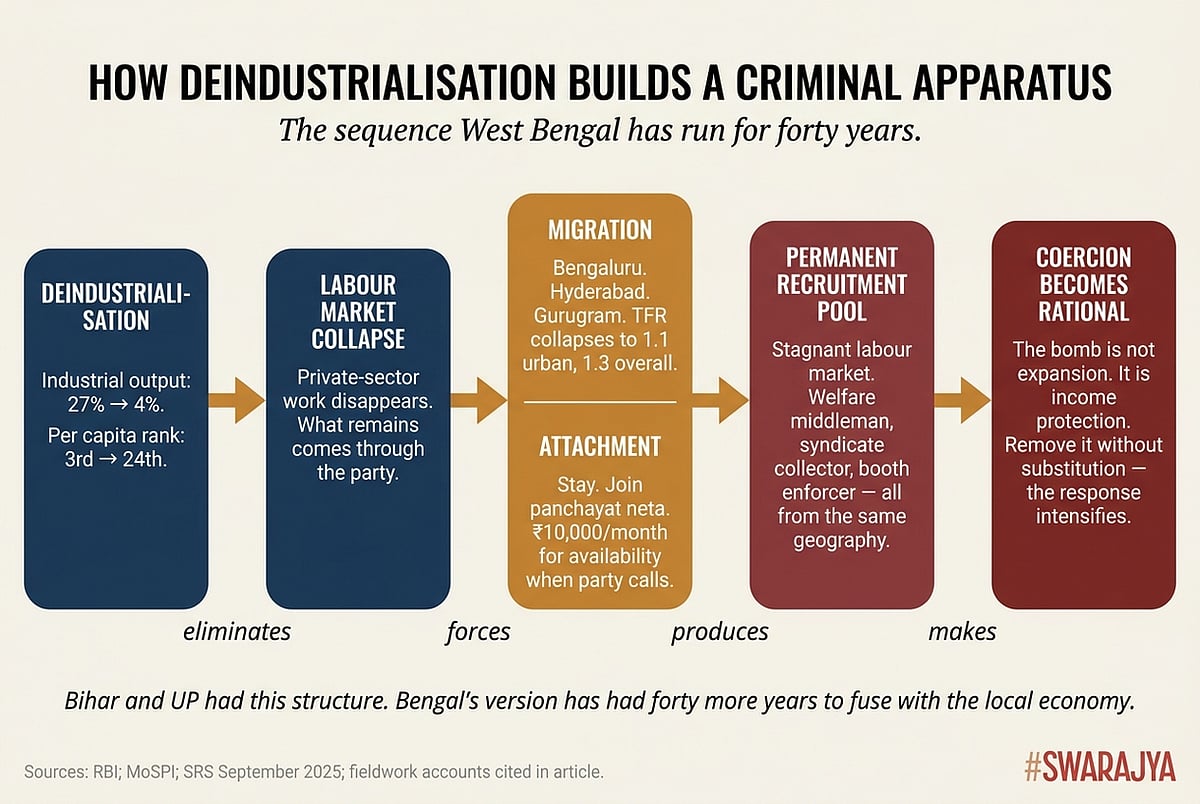
That changes the operational logic of any intervention. A protection network built around territorial expansion can be weakened by superior force and financial disruption. A protection network built around economic survival reacts differently because the local cadre is protecting one of the few remaining income streams available within his geography. The para network in Bengal functions simultaneously as political machinery, welfare intermediary, labour exchange and informal employer. Remove it without creating an alternative and the coercive response intensifies rather than collapses.
This is why the standard North Indian template cannot simply be photocopied onto Bengal. Encounters, Gangsters Act proceedings, property attachment and ED pressure can degrade the upper layers of the apparatus, but Bengal’s structure regenerates from below because the recruitment pool remains intact. The local club secretary, the syndicate collector, the welfare middleman and the booth-level enforcer all emerge from the same stagnant labour market.
Which is why any serious correction in Bengal has to proceed on two tracks at once. The coercive architecture has to be dismantled through sustained legal and financial pressure in the manner Uttar Pradesh and Bihar demonstrated. Simultaneously, the recruitment base feeding that architecture has to be drained through manufacturing growth, labour absorption and locally available private-sector work in the manner Bihar partially achieved after 2005.
Bengal simultaneously requires economic substitution at scale. Three urban clusters outside the Kolkata Metropolitan Area, each absorbing 200,000 working-age migrants over a decade, is the minimum demographic load that begins to shrink the crime apparatus from below.
This is the part of the lift India has historically not been willing to underwrite. The country has financed Bengaluru, Hyderabad, Gurugram and the new Pune-Chakan-Talegaon belt over the same forty years in which Bengal has been allowed to deindustrialise on its own.
The financing has followed the entrepreneurial class. The entrepreneurial class has followed the security of contract enforcement. The security of contract enforcement has followed police neutrality at the thana. The chain runs all the way back to the first front.
The migrant returns when the politics of the para no longer decides his work. The watcher stops paying sahayata when the local police register her FIR. The cadre finds a new line when the rent on the old one disappears. Bihar and UP have done two-thirds. The third, the manufacturing build, is harder than either, and Bengal, with its 1.3 TFR, has a decade to begin before the demographic window narrows further.
In Aranyer Din Ratri, the four young men return to Calcutta at the end of their few days in Palamau, and Ray leaves us with the quiet suggestion that the forest was never the dangerous place. The city was.
Fifty-seven years on, the men who killed Chandranath Rath travelled the other way, from Buxar and Ballia into a Bengal village, because the para-level cadre that once would have done the job is no longer confident it can.
المصدر: Swarajya