How to Save the Global Trading System
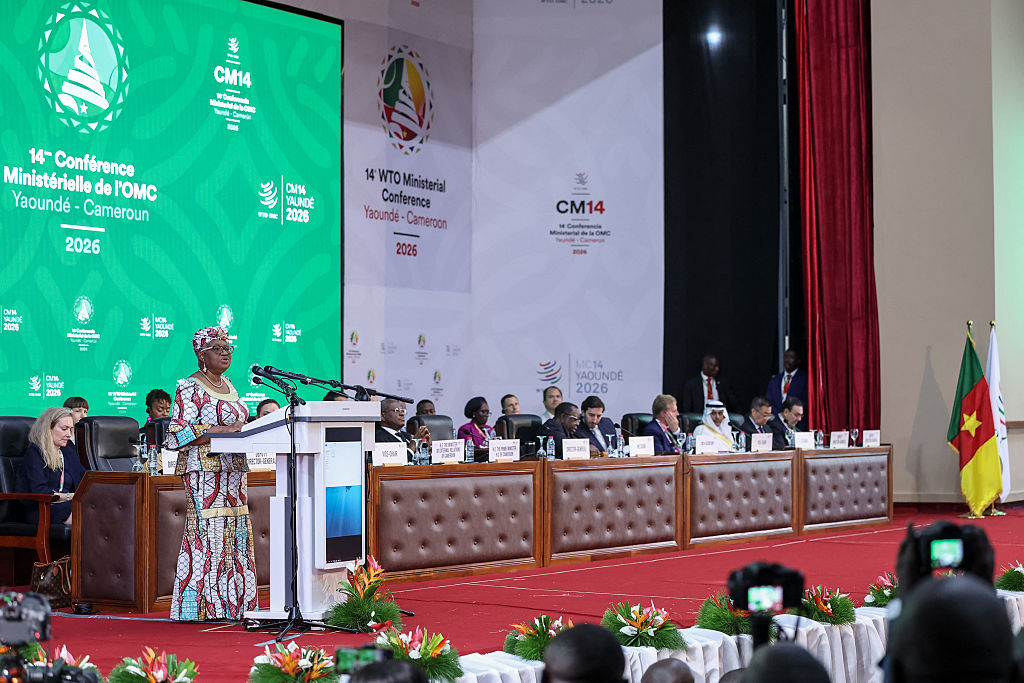
The future of the global trading system is on the line. President Donald Trump’s tariff wars are often cited as the principal source of today’s trade uncertainty, but American frustration with the rules governing global commerce predates the Trump Administration.
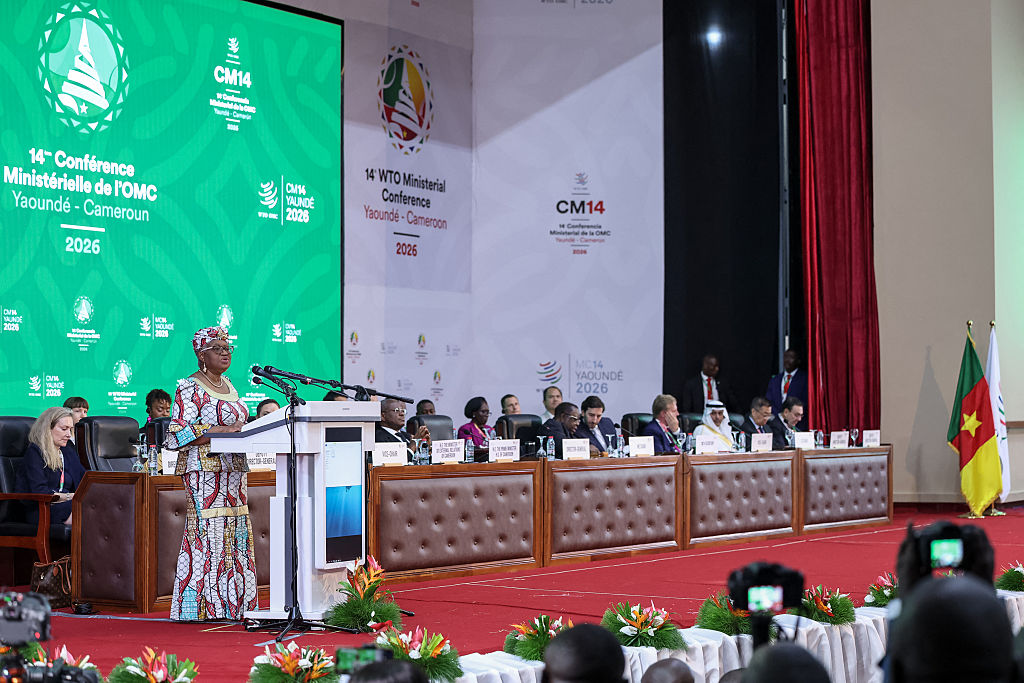
In late March, the World Trade Organization, the body that helps set rules for global trade and is a home for trade negotiations, held its ministerial conference in Yaoundé, Cameroon. Top trade officials from the 166 member nations attended to discuss the course of the organization. Hashing out a work plan for WTO reform, advancing negotiations on fisheries subsidies, and e-commerce were high on the agenda.
Despite this being a time of American unilateralism, Washington demonstrated its willingness to engage constructively by sending its Trade Representative, Jamieson Greer, to the Cameroon conference with a clear agenda to negotiate an extension of a pause on tariffs for digital products. However, he faced strong opposition from Brazil and Turkey, who criticized the US for not prioritizing issues such as agriculture, which are central to the bulk of the WTO’s developing country members. The American position of defending tariff-free digital trade was entirely consistent with past practice. Greer left empty-handed, frustrated by the meeting’s failure to produce any concrete outcomes.
Five weeks later, in early May, as the Iran war roiled global energy markets, trade ministers from the world’s seven largest economies met in Paris for the annual meeting of the Group of Seven (G7). Though the WTO conference had not yielded any concrete outcomes, Greer lent American support to a renewed call by the group for “meaningful reform” of the WTO to “respond to contemporary trade realities.”
One such reality is the inflexible manner in which member countries apply a foundational WTO rule: the requirement that its 166 members treat one another equally. With the US signaling a desire for candid discussions on reform, other countries should seize the moment to salvage the global trading system, but doing so will require filling a major crack in its foundations. For Washington, fixing the problems in the trading system also necessitates a departure from its coercive unilateralism to a more coordinated, rules-based solution.
At the heart of the problem lies a core principle known as “most favored nation” (MFN) trading status, which requires members to extend the same tariff and trade benefits to all countries. Exceptions such as offering lower tariffs to free-trade agreement partners exist, but they are limited.
American grievance and the global trading system
Since the founding of the postwar trading order in 1947, members of the General Agreement on Tariffs and Trade, the predecessor accord that was absorbed into the World Trade Organization in 1995, steadily lowered their tariffs and committed to keeping them below agreed-upon ceilings. The process continued after the formation of the WTO.
For developed countries such as the U.S., that history has become a constraint: there is little room left to maneuver when negotiating the terms of new trade agreements. For many years, this constraint did not matter much: average tariff rates are quite low, typically between 1.5% and 2.6%, though agricultural products attract steeper duties. Developing countries have much higher ceilings but often apply tariffs well below them in practice.
The central concern the U.S. has with MFN centers on countries that have flouted the spirit of the WTO’s founding promise: to enter “into reciprocal and mutually advantageous arrangements” that would eliminate discriminatory barriers to trade. As Greer testified before the U.S.-China Economic and Security Review Commission in 2024, China “took full advantage of this openness” and deployed “countless protectionist measures”—subsidies, forced technology transfer, and overcapacity—to game the system.
Now, as U.S. Trade Representative, Greer has set out to remake the trading system, pursuing so-called “reciprocal” tariffs with all trading partners and negotiating a range of deals designed to rebalance trade relations asymmetrically in America’s favor. But this unilateral approach will not succeed in creating a fairer trading system or address the structural problems of the WTO. Instead, it will simply erect a high tariff wall around the U.S., pushing trade toward other markets.
Truly remaking the trading system requires something far more ambitious than the limited deals the Administration has cobbled together so far, which may not even last past Trump’s tenure in office. For lasting change, Greer needs a fundamental redesign of MFN trading status, a radical step, though not without precedent.
In 1979, GATT members took a significant step toward acknowledging that not all trading nations were created equal. They established the Enabling Clause, which allowed developed country members to offer preferential market access to developing countries. This paved the way for the Generalized System of Preferences—a new approach to trade with developing countries that established criteria they had to meet to qualify for special trade treatment, such as providing adequate market access, protecting intellectual property, and worker rights.
This same concept can serve as the basis for rethinking MFN, but it requires flipping the logic of the Enabling Clause on its head. As we grapple again with the unfinished business of an earlier era of trade diplomacy, the US should lead efforts for WTO reform built around what I call the Disabling Clause.
The concept is straightforward: MFN status would no longer be a blanket guarantee but a conditional one extended only to members that demonstrate substantial compliance with their WTO obligations. The privilege would have to be earned, and it could be lost. This would fundamentally rewrite the WTO rule book.
But it would be entirely consistent with the founding spirit of the institution, which—much like differential treatment for developing countries—always viewed membership benefits as a privilege, not a right. The Enabling Clause bent the rules in one direction; the Disabling Clause would bend them in another, toward accountability.
Rewriting the global trade rules
Under this approach, MFN benefits could be suspended for any WTO member that has failed to honor its commitments. The mechanism could work as follows: any member could request the formation of an expert panel to evaluate an alleged breach, with support from the WTO’s administrative and economic divisions—operating outside the existing dispute settlement system to avoid its well-documented bottlenecks. The panel could investigate specific violations: serial non-compliance with dispute settlement rulings, material subsidy abuses, and trade-distorting operations of state-owned enterprises.
Upon finding a member in breach, all other WTO members would be required to suspend MFN benefits to that member state. To ensure predictability and guard against political manipulation, members would need to establish a new schedule of tariffs for any member state found in breach. Those tariff rates could be similar to the American “column 2” rates, the significantly higher tariff rates reserved for countries with which the US does not have normal trade relations, such as North Korea and Cuba. The precedent already exists in another form: Congress suspended Russia’s MFN benefits following the invasion of Ukraine.
The Disabling Clause would institutionalize that impulse, making collective punishment the rule rather than the exception. If every member publishes its own Disabling Clause tariff rates in advance, the consequences of rule-breaking become transparent and unavoidable. Tiered schedules could account for different categories of violations, ensuring that penalties are proportionate to the offense. Members could also publish a list of actions, in addition to tariffs, that would be triggered by a breach.
Together, these elements would provide a degree of stability that businesses crave, allowing them to plan for the possibility of MFN suspension without being blindsided by the erratic rate swings and exemptions that have plagued the current system. The message to rule violators would be clear: break the rules and face isolation from the trading system. And because every WTO member would be required to act in concert, there would be nowhere to redirect diverted trade.
Any member facing such a determination should, of course, be given the right to appeal to the WTO’s highest decision-making body, the General Council. Crucially, the panel report should also outline the pathway for rectifying the rule violations and set benchmarks for monitoring progress towards correction.
The goal is not permanent expulsion but the restoration of accountability: a process for ensuring that members honor the commitments they made when they joined. Some carve-outs would be necessary; least-developed countries would need exemptions, and greater flexibility would be warranted for developing nations that account for only a small share of global trade.
The true strength of the proposal lies in its capacity to discipline major rule violators collectively, rather than leaving any single country to act alone.
Compliance-based MFN could break the current deadlock over the trading system’s perceived unfairness by returning this vital debate to the WTO, where it belongs, rather than leaving it to the blunt instrument of American unilateralism.
It addresses a fundamental flaw in the architecture of the global trade rules and offers a workable solution to a recent U.S. request to revisit MFN. It also sidesteps the grinding delays of formal litigation, and establishes a mechanism for resolving concerns more expeditiously. Diplomacy has always been central to resolving conflicts at the WTO, and it remains the surest path for lasting change, one that requires genuine political buy-in.
This proposal is not perfect, but it provides a coherent framework for reforming MFN without dismantling it entirely. That matters enormously: more than 80% of global trade flows on MFN terms.
To remake the global trading system and to update the WTO to reflect contemporary realities, the U.S. must be willing to rebuild its foundations, and it must bring the rest of the world along for the project.
المصدر: TIME