I towed my caravan from Dorset to Cumbria – two service stations were a revelation

For decades, the British holiday followed a familiar pattern: pack the car, hit the road and disappear for a fortnight away. Starting in the late 1950s, motorways made it possible to leave work on a Friday and wake up the next morning in the Lake District, the West Country or by the sea.
The M4 became synonymous with people escaping the capital, the M5 with the West Country escape, and the M6 with Scotland and Cumbria. For decades, weekends meant queues of overheating cars and thoughts of the next stop.
That ritual hasn’t vanished completely, but it has changed. The traffic is more constant, but also more fragmented. Instead of a single mass migration, there are waves: weekend breakers, midweek remote workers and delivery vehicles keeping the economy moving. It all feels rather more hurried.
Not when you hook up a caravan, though: you’re limited to 60mph, unable to use the outside lane and nudged into a different rhythm entirely. One that’s all about steady speeds, predictable movements and patience.
It’s something I’ve observed during my two decades of caravan ownership, and I was reminded of it again when travelling 310 miles from my home in Dorset for a break in Cumbria.
With Bernard the Bailey caravan, safely hitched to my car and Clive, the rescue dog, ready to embark on his first caravan holiday, I hit the M4. While other cars streamed past, I settled into the inside lane with the HGVs and drivers who – for one reason or another – had opted out of the rush.
Empty articulated lorries became my pacesetters, their drivers steady and predictable. There was something calming about it all – instead of chasing gaps in the traffic, it felt like I was letting the journey come to me.
I also noticed things I might otherwise have missed. At one point, I found myself alongside a lady deep in conversation – not on the phone, but with her dog, which was perched upright in the passenger seat, belt on. In the outside lane, you’d never catch these moments. Here, along with the older cars and van drivers in no hurry to get to the next job, they’re part of the inner lane ecosystem.
After the M4, my journey took me along the M5 and – due to a snarl-up – the M42, followed by the M6 Toll and, finally, the M6. I breezed through sections of rolling Worcestershire countryside, busy Birmingham junctions and leafy stretches of Lancashire.

The latter was the UK’s first county to have a motorway: the Preston Bypass, which was later incorporated into the M6. It opened in 1958, and when the first stretch of M1 arrived the following year, it brought with it another modern phenomenon: the service station.
For a time, service stations were destinations in their own right, with viewing platforms and smart restaurants. The most striking reminder still stands over the M6 at Forton Services, now known as Moto Lancaster Northbound.
Its futuristic, air traffic control-like Pennine Tower was once a full-service restaurant where families didn’t just stop, they arrived. Often dressed in their Sunday best, travellers enjoyed table service from staff in airline-style uniforms inside a building that cost £885,000 to build, around £15m in today’s money. The menu included chilled melon, grilled Dover sole and gammon steak with pineapple, as well as local specialities such as Morecambe Bay potted shrimps.

Today, this monolith stands abandoned because most modern drivers prefer to close the gap from A to B as quickly as possible in the service station over which it looms. A quick-in-and-out ethos is applied to parking and fast-food queues at the former Forton site; it has been tailored to the 21st-century driver with the usual suspects – Costa Express, KFC, Greggs – although it was nice to see the Pennine Tower’s bio displayed on laminated A4. One visitor told me that postcards are sometimes available, showing Forton’s former glory.
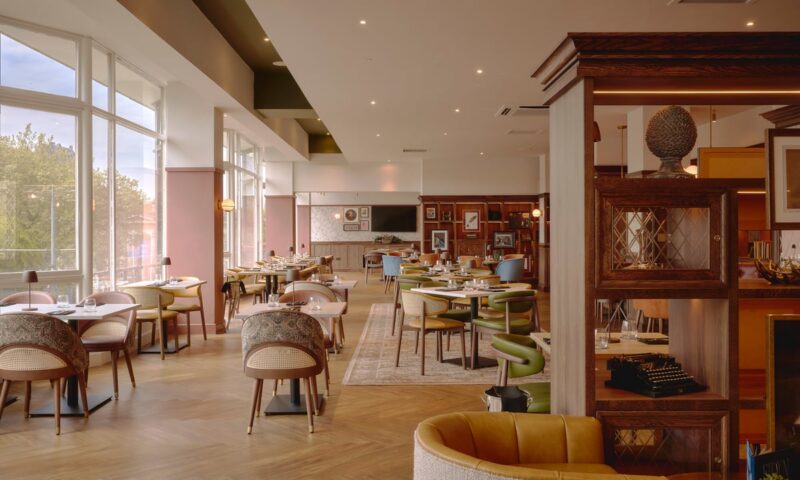
Not all services are purely functional, however. Earlier in my journey I’d stopped at M5 Gloucester Services – a clear attempt at reviving the destination service station for the modern day.
Having parked Bernard in one of the dedicated bays alongside a handful of motorhomes and caravans, I stepped inside the farm shop. The shelves were stocked with local produce and trinkets, from gifts for the home to skincare.
The kitchen prepared fresh meals from scratch using locally sourced ingredients. It was a welcome interlude and a reminder that some road-trippers still want more from their stops than a quick loo run and a pre-packaged sandwich.

Yes, there’s a “Quick Kitchen” menu – hot drinks, breakfast rolls, soups, pies and salads – but there are also shawarma-filled flatbreads, tagine and sausage with mash. Instead of rows of fast-food screens being tapped at by folks desperate to continue their journey, the restaurant-like experience here gave visitors the time to chat and relax.
After seven hours on the road, including two breaks, I reached Windermere, but the drive was much more than a means to an end. Towing a caravan doesn’t just slow you down – it changes your perspective.
From the inside lane, Britain’s motorways aren’t simply routes from A to B. They’re a moving snapshot of how we live, work and take our holidays – occasionally serving as a reminder that the journey itself still matters.
المصدر: iNews