India’s Healthcare Workforce Spent Decades In Regulatory Limbo — NCAHP Act Was A Much-Needed Reset
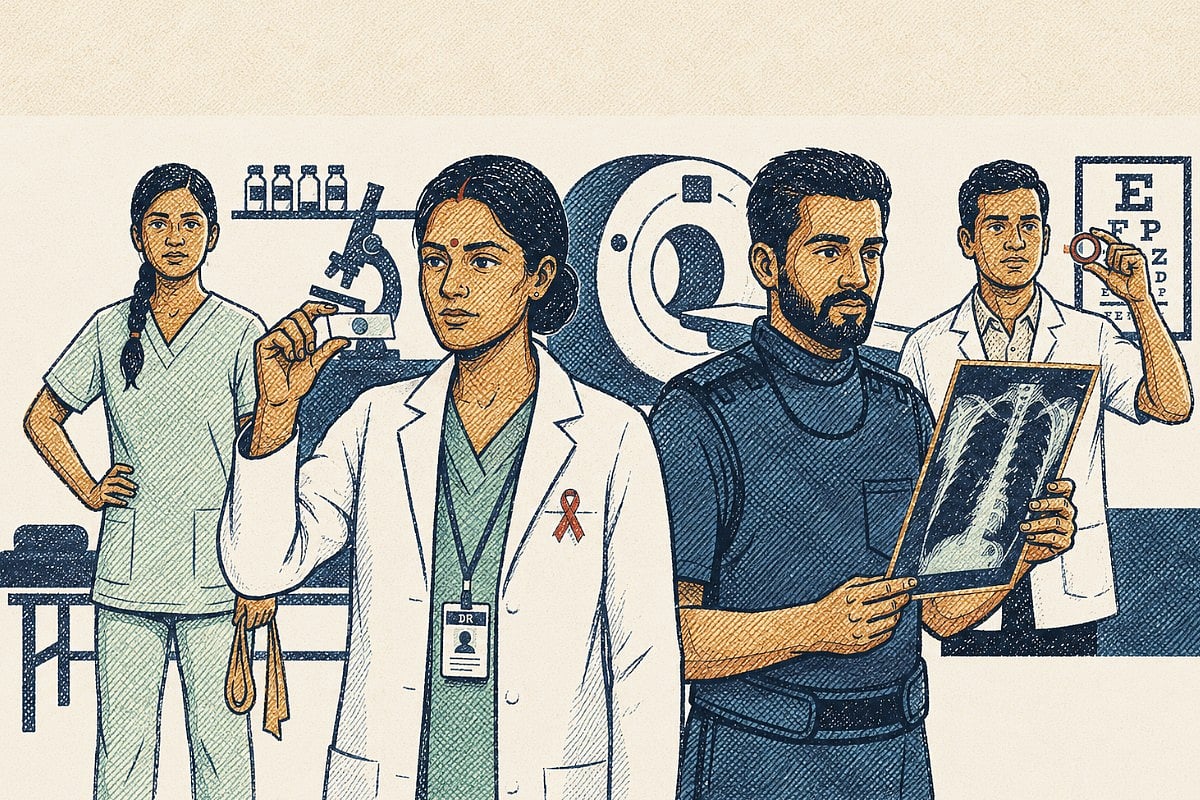
Thirteen lakh radiographers, lab technologists, physiotherapists and optometrists were trained on the job, governed by patchwork state rules, and absent from the country’s national healthcare conversation.
Five years after the Act gave them a single institutional home, the gap between what is built and what still needs building is the policy question that defines the sector’s next decade.
For decades, India’s healthcare conversations have centred around doctors, nurses, hospitals and infrastructure. Behind every critical diagnosis, every medical procedure and every successful discharge lies a team of professionals who have long been left unseen and ignored.
Five years ago, that conversation finally shifted. The allied and healthcare sector was unified under a single national umbrella and accorded statutory regulatory recognition as the NCAHP Act came into force. The National Commission for Allied and Healthcare Professions (NCAHP) Act, 2021 instituted the National Commission for Allied and Healthcare Professionals as the designated regulatory body for the sector.
Numbering around thirteen lakh and forming nearly sixty per cent of India’s healthcare workforce, allied and healthcare professionals (AHPs) form the backbone of the sector. They range from laboratory technologists, radiographers, optometrists and physiotherapists to anaesthesia technologists and a dozen other specialisations.
The initial committees and regulations that laid the foundation for modern health services in India acknowledged the need for ‘paramedical personnel’ but prioritised producing doctors and nurses, keeping allied and healthcare on the back burner. For decades, AHPs were trained through informal, on-the-job apprenticeships in hospital labs and X-ray rooms rather than through structured academic degrees. Regulatory frameworks were non-existent or extremely weak.
Allied and healthcare governance eventually began developing through a patchwork of state-level regulations and governance measures. The resulting regulatory asymmetry meant that a workforce central to healthcare delivery was governed through uneven and decentralised frameworks.
The private sector in healthcare boomed in the meanwhile, and unregulated diplomas and ‘degrees’ in allied and healthcare proliferated. A quality crisis brewed in which one worker might hold a two-year diploma while another had completed four years of training, with no national standard distinguishing the two.
Given that human lives rest on the work of allied and healthcare professionals, regulating the sector became an agenda too important to ignore. A departmental standing committee was formed, and on accepting its recommendations, Parliament passed the NCAHP Act in March 2021, lending national institutional recognition to the sector.
The Act broadly created a national structure of governance: a National Commission (the NCAHP), professional councils and autonomous boards, central and state registers, ethics and disciplinary mechanisms, and an overriding effect over inconsistent state laws.
For the first time, the Act clearly defined and recognised AHPs as associates, technicians or technologists trained to support the diagnosis and treatment of any illness, disease, injury or impairment. In place of inconsistent degrees, the Act fixed the duration of training for allied and healthcare professionals at a minimum of 2,000 hours over two to four years, and for healthcare professionals at a minimum of 3,600 hours over three to six years.
The NCAHP was constituted and mandated with framing policies and standards for regulating education and practice, maintaining an online central register of all registered professionals, providing basic standards of education and curriculum, and providing for a uniform entrance and exit examination. Similar councils were constituted at the state level. A sector that had lain fragmented and ignored in healthcare policy was finally granted its due at centrestage.
The NCAHP’s achievements in five years are nothing short of a feat to be celebrated. The Commission has rolled out updated, competency-based curricula for seventeen core allied and healthcare courses, creating uniform educational and training standards across all Indian institutions in the field.
These curricula are mandated to be uniform across India, given that ‘One Nation, One Curriculum’ is one of the guiding principles of both the NCAHP and the Act. With this, the NCAHP has also ensured pan-India mobility of AHPs.
The Commission updated admission frameworks, introducing entrance and exit examinations for many associated undergraduate courses and fixing quality standards for allied and healthcare programmes. In line with India’s digital push, it has built a robust digital footprint by actively enrolling allied and healthcare professionals into the Healthcare Professionals Registry under the Ayushman Bharat Digital Mission. The Registered Allied and Healthcare Professionals (Professional Conduct and Ethics) Regulations, 2026 have been notified to codify accountability and check malpractice in the sector.
The Commission has actively supported the formation of twenty-six state councils in line with the Act and is supporting their operations. It has also worked towards positioning Indian allied and healthcare graduates for easier recognition and cross-border mobility, creating financially upward mobility for professionals and serving as a valuable source of remittances for the nation.
Mandating clinical exposure for students of the field is another step in the right direction. The Commission has laid the groundwork to cultivate globally competent allied and healthcare professionals, equipped to meet the rising burden of disease and the increasing demand for allied and healthcare services.
As the broader Indian healthcare industry scales past $610 billion, the allied and healthcare space is transforming from an unorganised workforce into a formalised, high-growth sector. Areas like pathology and diagnostics are expected to nearly double in demand in the coming years. Corporate and private hospitals are aggressively adding beds and attracting both investment and demand for allied and healthcare professionals.
Amid efforts by the ministry and the NCAHP, the demand side of the sector is showing encouraging signs of growth and consolidation. Private sector participation is growing strongly, with players such as Virohan, Manipal and Symbiosis entering the educational and training part of the sector. Indian-trained AHPs are witnessing strong demand both domestically and globally, with mobility trending upward.
The sector still carries challenges of its own. A demand-supply mismatch looms large, with production of only two lakh certified AHP graduates every year against a demand of nearly ten lakh AHPs annually in the workforce. Regulatory bottlenecks remain in the implementation of the NCAHP Act, alongside ongoing challenges in the transitional regime.
Five years into the new regime, the sector faces the larger challenge of regulatory cholesterol seeping into the critical transitional period. The choke-points include non-uniform credit structures within allied and healthcare courses, which dilute the core idea of ‘One Nation, One Curriculum’; rigid provisions for institutions and internships; and a curriculum that, being modelled on the general medical professionals’ curriculum, often does not do justice to the sector. Rigid capping of seats in institutions and an over-complicated approval process for new institutions do not help the case either.
A few recommendations may be considered for more deregulated and smoother implementation of the Act and the Commission’s mandate. The NCAHP should consider implementing the UGC’s National Credit Framework, a step that will significantly improve student mobility and the interoperability of learning in the system.
Provisions for institutions covering internships, capping of seats and approval processes for new institutions should be eased and based on the principle of ‘trust but verify’. Degree programmes should feature an increased focus on practice-based learning, which may extend to as long as one year. Government focus needs to increase on Information, Education and Communication for the allied and health sciences, and on professional pathways for potential young entrants.
Land-based regulations should be amended to be dynamic rather than rigid, which is currently a major deterrent for new players entering the space. Such regulations should focus on functional infrastructural needs and stay open-ended enough to accommodate modern campuses.
Subject-specific curricula should be reimagined based on allied and healthcare standards and not modelled directly on professional medical courses; they should also be made interoperable with global standards for enhanced mobility. Rigid prescriptions should be replaced with functional adequacy, sharing of training infrastructure should be allowed and operationalised, and innovative pathways like Professor of Practice should be opened up.
With a growing population and a demographic transition towards an older population, combined with a rise in the non-communicable disease burden, the demand for healthcare in India will continue to rise. The allied and healthcare sector and the AHPs are key pillars in India’s vision of a Swasth Bharat. With considerable feedback and support from the private sector and an increasing policy interest in the space, the NCAHP will see growing support for its work in the coming days.
The government has allocated Rs 1,000 crore to train and certify one lakh allied and healthcare professionals over the next five years. This is a testament to the sector finally finding its rightful place in India’s healthcare priorities.
The utilisation of this sum and its efficient distribution between players and initiatives will be a key determinant of the course of the sector in the near future. An open-minded approach, a slew of innovative measures, and regulatory loosening as the sector reaches maturity will pave the path towards making India a global leader in the allied and healthcare space.
المصدر: Swarajya