Liberia: Hung Jury Forces Mistrial in Bracewell Murder Case as Doubts Shadow Prosecution’s Evidence
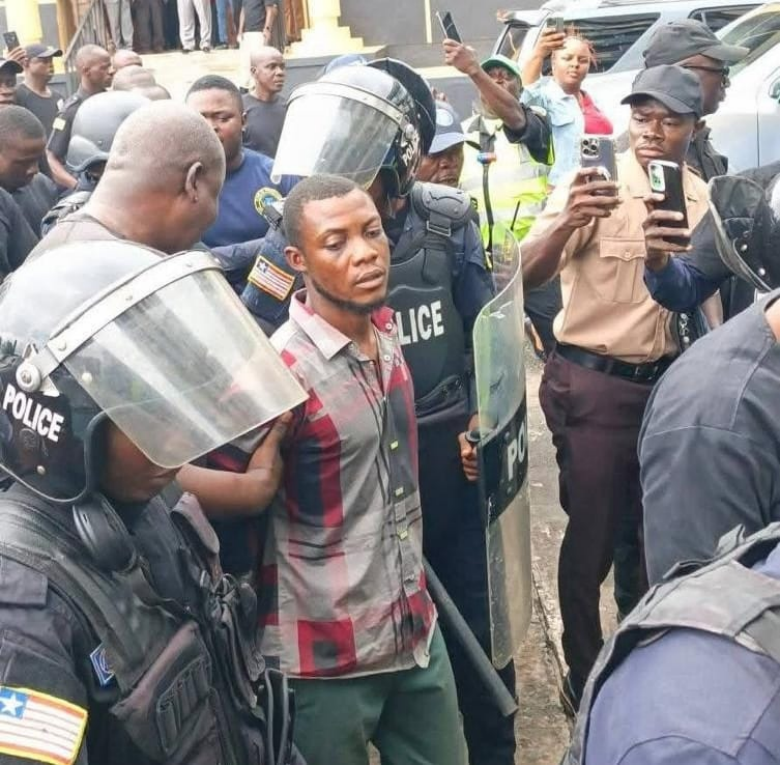
Monrovia – A dramatic turn unfolded Monday, May 18 at the Criminal Court “A” as the murder trial of commercial driver Francis Nana ended in a mistrial, following a deadlocked jury that split evenly on the defendant’s fate.
By Willie N. Tokpah
After hours of deliberation, jurors returned a six-to-six verdict, six voting not guilty and six voting guilty, effectively halting proceedings in a case that has gripped public attention and raised broader questions about
Investigative standards and prosecutorial burden in Liberia’s justice system.
Nana had been accused by state prosecutors of causing the death of Mark D. Bracewell, an officer of the Liberia National Police(LNP), during a traffic encounter in Monrovia.
The prosecution argued that Nana acted with criminal intent, allegedly dragging the officer with his vehicle in a fatal sequence of events.
However, the defense consistently maintained that the incident was a tragic accident, not a deliberate act, pointing to mechanical failure and a lack of intent to kill.
Notably, the defendant was represented by Attorney Jeremiah Samuel Dugbo I on a pro bono basis, personally covering all legal expenses.
The case has taken a heavy toll on Nana’s family, with his three children reportedly forced out of school due to the prolonged trial and incarceration at the Monrovia Central Prison.
Even before the jury retired to deliberate at 10 a.m. on Monday, May 18, emerging inconsistencies within the prosecution’s case had begun to cast a long shadow over its ability to meet the legal threshold required for a murder conviction, proof beyond a reasonable doubt.
The state presented six witnesses during the trial, the majority of whom were officers from the same institution directly tied to the incident and its investigation.
Aside from a medical doctor who confirmed the victim was dead on arrival, all testimonies originated from within the police force, a point the defense highlighted as potentially undermining objectivity.
The prosecution’s first witness described a scene of recklessness, alleging that Nana sped from Johnson Street, ignored police intervention, and struck Officer Bracewell with significant force.
Yet, the second witness offered a conflicting narrative, testifying that Nana had actually stopped at a checkpoint and interacted with the officer before the incident occurred.
These incompatible accounts introduced uncertainty about the sequence of events, uncertainty that may have weighed heavily on jurors.
Further scrutiny arose over how the defendant’s vehicle was examined. The Chief of Motor Pool for the police admitted under oath that the mechanical inspection conducted after the defense raised brake failure, occurred without the presence of the defendant, his legal counsel, or any independent expert.
Instead, the assessment was carried out solely by police mechanics acting on instructions from superiors, raising concerns about transparency and procedural fairness in a case where mechanical failure could be central to determining culpability.
The prosecution’s timeline also came under serious strain. The Chief Accident Investigator acknowledged that the official accident report was dated October 8, 2025, ten days after the incident and a full week after Nana had already been formally charged and forwarded to court for murder on October 1.
This sequence raised a critical question: whether the charge was brought before the investigation had been fully completed.
Compounding these concerns, the investigator conceded that the report did not include any statement from the defendant, relying exclusively on accounts from fellow officers.
The absence of Nana’s version of events from such a pivotal document became a focal point for the defense’s argument on investigative imbalance.
Adding another layer to the defense’s case, the Liberia National Police mid-year report for 2025, published on its official platform, indicated that accidents recorded during that period did not constitute murder, raising questions about the legal framing of the charge brought against Nana.
Perhaps most consequential to the jury’s deadlock was the prosecution’s failure to establish motive or intent, a cornerstone of any murder charge.
Throughout the trial, no evidence was presented to suggest prior hostility, threats, or any form of conflict between Nana and Officer Bracewell.
In a legal context where intent must be proven, this gap may have proven decisive. With the mistrial declared at Criminal Court “A,” the case now enters a period of uncertainty.
Legal analysts say the state must decide whether to retry Nana, a move that would require reassessing the strength of its evidence and addressing the weaknesses exposed during the first trial.
For now, the case underscored an issue within Liberia’s criminal justice system: the challenge of securing convictions in complex cases where investigative procedures, evidentiary standards, and institutional credibility are all placed under intense scrutiny.
المصدر: FrontPage Africa (Liberia)