Teens need to press pause on late-night doomscrolling
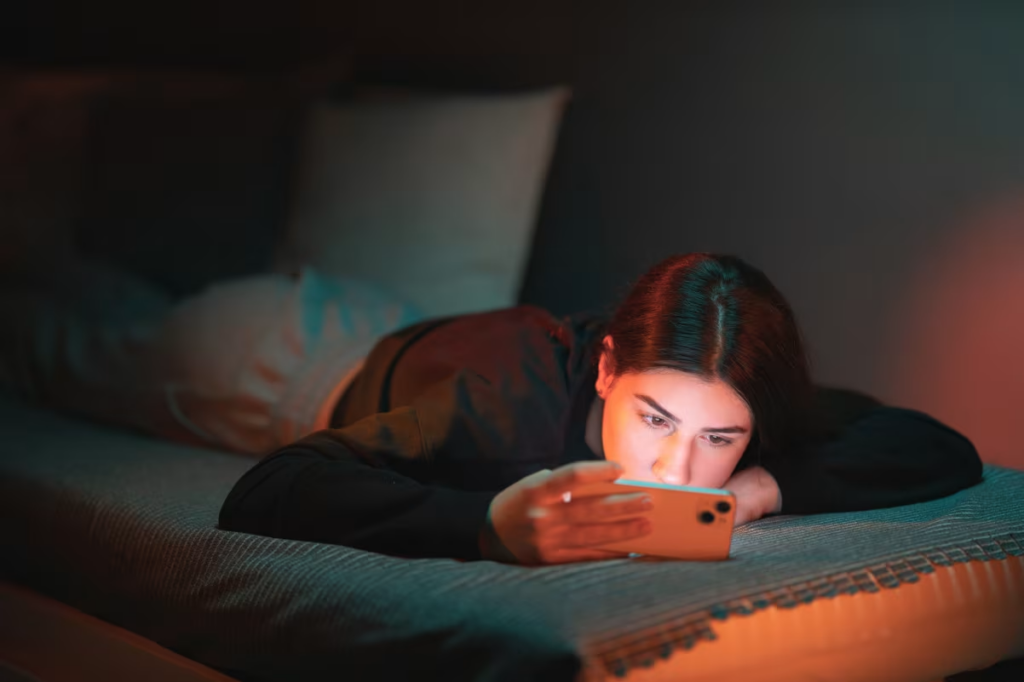
Teens’ glued-to-their-phone habits are turning many of them into night owls on school nights — at a time when they need all the sleep they can get.
The American Academy of Pediatrics and the American Academy of Sleep Medicine recommend that teenagers get eight to 10 hours of sleep every night.
But more than half of teens in the United States are spending up to an hour or more on their phone between the hours of 10 p.m. and 6 a.m. on school nights, new research has found.
Additionally, more than half of teens were using their phones in the middle of the night, between 12 a.m. and 4 a.m., according to lead study author Jason M. Nagata, associate professor of pediatrics at the University of California, San Francisco.
Nagata and his colleagues analyzed data collected from the Adolescent Brain Cognitive Development Study, which shows how teenage phone-use patterns and specific types of uses cut into sleep during nighttime hours.
Although the research doesn’t directly link nighttime phone use to harmful outcomes for teenagers, previous research has shown sleep disruption does have negative impacts.
“By displacing the opportunity to sleep, it can be challenging for teens to get adequate sleep, and that has downstream impact on their waking behavior, as we’ve known for many, many years,” said Dr. Mary A. Carskadon, professor of psychiatry and human behavior at Brown University. She was not involved with the study.
Lack of sleep impacts a lot
Getting inadequate sleep can affect people in numerous ways. For teens, who are at an age when the brain and body are developing, sleep loss has even greater consequences.
Cognitive function is impaired when the body isn’t well rested. It becomes more difficult to consolidate and retain information acquired throughout the day.
“One of the life tasks for teenagers is to learn,” Carskadon said. “Whether it’s school learning, learning their sports, how to behave with other people, social interactions, there’s a lot of learning building up across the adolescent age span.”
Emotional regulation worsens with poor sleep. In a 2013 study, a group of healthy adolescents between the ages of 14 and 17 participated in a three-week experiment that started with a typical week of sleep. Next came a week of sleep restriction with 6 ½ hours of shut-eye per night, followed by a final week of healthy sleep with 10 hours each night.
The participants rated themselves as slightly more anxious, angry, confused, and fatigued during the sleep-restriction period compared with the healthy sleep period. The adolescents and their parents also reported more irritability and poorer emotional regulation.
The less sleep a teenager has, the more irritable they become,” Carskadon said. “Parents will tell you that it’s one of those no-brainer kind of conclusions.”
For certain more vulnerable youth, less sleep can pose risks to their mental health. Nagata noted that past research suggests sleep-deprived kids are at higher risk of depression and anxiety symptoms. Lack of sleep could also make teens vulnerable to suicidal ideation, self-harm, and risk-taking, Carskadon said.
Adolescents focused their screen time on apps featuring social media, entertainment, games, communication, and music, according to Nagata.
Teens spent the most time — an average of 33 minutes every night — on apps such as YouTube, Instagram and TikTok.
When asked for comment, YouTube provided links to its website with information about parental controls.
TikTok and Instagram did not respond for comment by the deadline.
Carskadon pointed to the active engagement required for most of these apps as an added disruption to overall sleep.
“When you’re supposed to be sleeping, your arousal levels need to go down, but those are the kinds of interactions that amp up your arousal and make it harder to sleep,” Carskadon said.
Late-night phone scrolling can delay bedtime, but the buzzing, ringing, and light from notifications can also fragment sleep throughout the night, experts say.
There’s also a behavioral, or habit, loop associated with picking up or checking the phone immediately after waking up. When a notification pings in the middle of the night, the immediate reflex is to check the phone.
Nagata led a separate analysis in 2023 using data from the Adolescent Brain Cognitive Development Study. In this report, he and another team of researchers found that 17% of adolescents reported being woken up by phone calls, text messages or email while sleeping at least once per night.
Moreover, 20% reported using their phone if they woke up overnight.
“All of sudden you see these messages and that can reactivate them and make it harder to fall asleep,” Nagata said.
Making a family plan
Addressing the issue of nighttime phone usage isn’t a task teenagers should tackle alone. Building healthier habits starts with parents, Nagata and Carskadon said.
Parents need to be role models for the behavior they want to see in their teenage kids. As a family issue, it can be more challenging to minimize or control the behavior if it isn’t consistently enforced and expected from everyone.
“I think it’s important for parents to model healthy screening behaviors,” Nagata said. “We also found that one of the top predictors of teenagers’ screen use is actually their parents’ screen use.”
One of the recommendations from the American Academy of Pediatrics is to create a family media plan that guides the entire household to have healthy screen habits.
Some suggestions are to create screen-free zones in the home and times when you cannot be on a device. Set guidelines on how long devices can be used and place limits. Planning activities that don’t involve screens is a good way to fill up time that otherwise would include a device.
Keeping phones and other devices out of bedrooms is also recommended, and Carskadon suggests creating a “family media lockbox” that forces household members to physically separate themselves from their devices.
“It’s not just a teen issue; it’s a family issue,” Carskadon said.
المصدر: MyJoyOnline (GH)