These Malaysian teens are building startups while juggling homework and exams
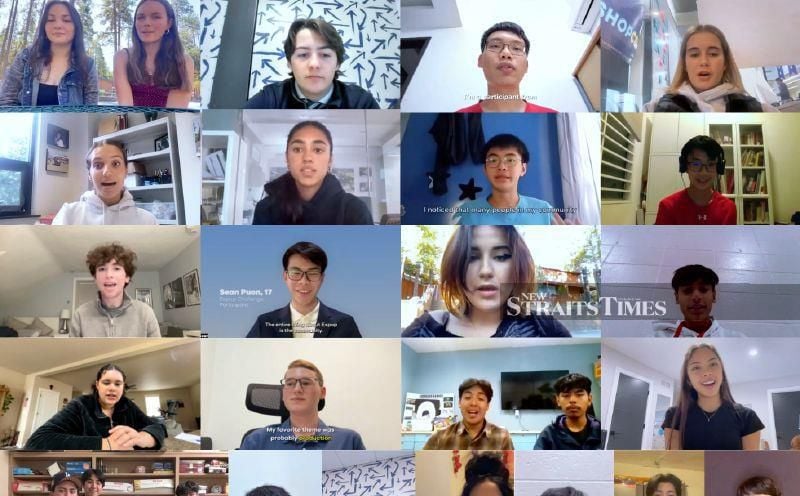
MOST people wait until they feel ready. They wait for the perfect idea to arrive fully formed — polished, convincing and impossible to fail. They wait until they have enough knowledge, confidence or certainty to finally begin.
Students Bryan Chu Yong Xiang, Wong Kean Jee and Sean Puon did not.
None of the three Malaysian teenagers started with a complete blueprint for
success. They did not have polished business strategies, years of experience or certainty about where their ideas would eventually lead. Instead, what they had was curiosity, persistence and the willingness to start before everything made sense.
That decision eventually brought them onto an international stage at the Expop Startup Challenge Grand Finale in the United States recently. Hundreds of students from across the region gathered online to showcase businesses that they had spent six months building from the ground up.
But the real story did not happen during the final presentations, neither was it in in the moment their names were announced among the winners.
It happened long before that — in late nights spent rewriting code, in moments of self-doubt, in failed prototypes, in awkward first-sales pitches and in the constant balancing act between school life and entrepreneurship.
DEMANDING PROCESS
[[nid:1446922]]
Among more than 200 students from over 18 schools across five countries, the three Malaysians emerged strongly. Chu, 16, secured second place and US$2,000 in prize money for Crave Cave, a grab-and-go snacks and beverages brand.
Meanwhile, Wong, also 16, emerged third with Deskmindr, a compact desk companion designed to help users organise tasks and reduce digital clutter. Puon, 17, came in fourth with Willforge, an accountability-focused app aimed at helping users build discipline and consistency.
For teenagers still juggling assignments, examinations and everyday school life, the achievement was significant. Yet behind the recognition was a far more demanding process than many might expect.
Over the course of six months, students in this online entrepreneurship programme were required to develop their ideas into functioning businesses. That meant testing concepts, refining products, pitching to customers, managing setbacks and learning how to adapt quickly when things did not go according to plan.
According to Expop co-founder Heerraa Ravindran, that uncertainty was intentional.
“Most students don’t start with a clear idea,” she shares, adding: “But when you give them the space to explore, they figure it out and that’s where the real growth happens.”
That philosophy sits at the centre of Expop, a programme designed to move students beyond classroom theory and into real-world execution.
She continues to explain: “Expop is about going beyond theory. These students aren’t just pitching classroom-level ideas. They’re creating their own brands, doing their own marketing, making sales and actually running a business. That’s where real learning happens.”
The process, however, was far from smooth.
CHALLENGES APLENTY
[[nid:1446921]]
For Puon, the journey began not with a groundbreaking concept, but with frustration.
He admitted he initially had no clear idea of what he wanted to build. The turning point came after receiving a simple piece of advice from his father: solve a problem you personally face.
And for him, that problem was consistency.
Like many students, he had experimented with productivity apps before, only to find that most of them failed to sustain long-term discipline. Over time, he realised the problem was not planning tasks — it was actually following through on them.
[[nid:1446920]]
That insight became the foundation for Willforge, an app focusing less on productivity and more on accountability. The concept encourages users to stay committed to their goals even on difficult days, when motivation begins to fade.
“Even if it’s just 10 per cent, you’d still show up and do the work,” says Puon.
The idea sounded straightforward in theory. Building it was another matter entirely.
He spent months repeatedly rewriting the code for the app, fixing problems, simplifying functions and learning which features truly mattered. One of the hardest lessons, he said, was resisting the temptation to continuously add more functions instead of refining the core purpose of the app.
“It’s easy to add in new features,” he says, adding: “But it was much harder to focus on solving one problem really well.”
The process tested both his patience and confidence. Yet he persevered, driven less by competition and more by the belief that the project meant something personally to him.
That sense of personal connection also shaped Wong’s journey.
Unlike Puon, whose project revolved around discipline and accountability, Wong focused on a challenge many students quietly struggle with — feeling overwhelmed.
As someone constantly balancing between his schoolwork, responsibilities and deadlines, he often found himself losing track of tasks or forgetting important reminders. The endless flood of digital notifications only made things feel more chaotic.
He explains: “I find it really hard to keep track of my tasks. So, I decided to come up with this physical desk companion which helps you to keep in charge of your tasks and your reminders.”
[[nid:1446919]]
The result was Deskmindr, a hybrid system combining an application with a physical desk companion designed to help users organise their responsibilities while reducing digital clutter.
What made the achievement particularly remarkable was that Wong had no prior background in coding or engineering.
He built the prototype largely through self-learning, sourcing parts from Shopee and Lazada, experimenting through trial and error, and turning to artificial intelligence (AI) tools for assistance when he encountered technical problems.
Progress came slowly. With only a few hours available after school each day, he had to learn how to manage his time carefully while balancing between academic commitments and project development.
“The whole process was painful but fun,” he admits with a laugh. “Every milestone made me want to keep going, even though it was hard.”
His words reflect a recurring theme shared by many young entrepreneurs: the satisfaction often comes not from instant success, but from surviving the difficult stages in between.
MINDSET CHANGE
[[nid:1446918]]
Chu’s journey, meanwhile, took a more practical and immediate direction. Unlike the app-based projects created by Puon and Wong, his startup emerged from observing everyday behaviour at school.
He noticed two things almost immediately: students were constantly hungry, and many were struggling after the canteen transitioned to card-only payments.
Rather than seeing it as an inconvenience, Chu saw an opportunity.
His business, Crave Cave, began as a simple idea — affordable RM1 snacks with flexible payment methods that students could quickly grab between classes. What started casually soon evolved into a full operation involving inventory management, sales tracking and customer demand forecasting.
“I noticed my classmates were always hungry and I thought to myself: they’re hungry for food and I’m hungry for money,” says Chu, chuckling softly.
Beneath the humour, however, was a sharp understanding of his market.
Chu understood his customers because he was one of them. He knew what students wanted, what price points worked and what products sold fastest during recess breaks. Yet despite understanding the business side, his greatest obstacle turned out to be something far more personal: confidence.
“Because I was quite shy during the first month, I was really scared to approach anyone to sell my product,” he admits.
For a teenager trying to sell snacks to peers in a school environment, the fear of embarrassment and rejection felt real. But over time, Chu realised that avoiding discomfort would only prevent the business from growing.
Expression earnest, he confides: “I kept thinking to myself: if I don’t promote my own product, no one will do it for me.”
That shift in mindset changed everything.
Gradually, Chu became more comfortable speaking to customers, promoting his products and managing sales. Eventually, he was selling up to 40 packs a day on average while building a loyal customer base in school.
REAL WORLD
[[nid:1446917]]
According to Heerraa, these moments of discomfort and adaptation are precisely what the programme aims to cultivate.
“When you give young people the space to try, they manage to surprise you,” she says, adding: “They learn things like managing customers, dealing with suppliers and even handling failure like a pro. These are things you can’t fully teach in a classroom.”
That distinction is what separates Expop from many academic competitions.
Rather than focusing solely on presentations or theoretical business ideas, students are required to execute their concepts in real environments. They must test whether their ideas actually work, whether people are willing to pay them and whether they can adapt when obstacles arise.
The approach reflects a broader shift in how many younger people now view learning.
Explains Heerraa: “They want hands-on experiences. They don’t just want to study for exams. They want to build, test and see how things work in the real world.”
For the students themselves, the programme also opened doors beyond entrepreneurship alone.
Throughout the challenge, participants collaborated with international peers and gained exposure to mentors from major companies, such as Google and LinkedIn.
For teenagers still in school, the experience offered a rare glimpse into global perspectives, innovation and professional environments usually encountered much later in life.
“The experience made me realise that understanding global perspectives is just as important as the solution itself,” reflects Puon.
Yet perhaps the most significant transformation was not external, but internal.
Over the course of six months, the students learned how to tolerate uncertainty.
They learned how to continue despite imperfect conditions, limited experience and moments where failure seemed possible.
For Puon, the lesson became deeply tied to persistence. Smiling, he says: “The experience made me realise that a step is still a step. Even if it’s small, you can always figure things out along the way.”
Wong, meanwhile, came away with a stronger understanding of motivation and purpose.
“You can start on whatever you want,” he says, “but most importantly it is to find out what you like because it will give you the motivation and the discipline to keep going. You’ll be looking forward to taking that next step of your project. This will definitely build that consistency, which will ultimately lead to success.”
Chu’s takeaway was perhaps the simplest, yet also the most universal.
“Everyone is afraid of being judged,” he says, adding: “But the only judgement that matters is the one in your own mind. Just start and don’t let your doubt stop you.”
OF PERFECTION AND MOMENTUM
[[nid:1446916]]
In many ways, their stories are not really about winning prize money or placing among the top participants in an international competition. They are stories about learning how to begin before feeling fully prepared.
For adults, entrepreneurship is often framed around scale, funding and profit. But for these teenagers, the process was far more fundamental. It was about learning how to trust an idea enough to try it. Learning how to recover when things failed and solving problems that felt personal and meaningful.
There is also something quietly refreshing about the simplicity of their motivations.
Puon wanted to solve his struggle with consistency, while Wong wanted to manage the overwhelming clutter of daily tasks. Chu simply noticed hungry classmates and recognised an unmet need.
None of the ideas began with grand declarations about changing the world.
Instead, they started with observation — small frustrations, ordinary routines and problems close to home. Perhaps that is precisely why they resonated.
Their journeys also challenge the assumption that young people must wait until adulthood before taking their ideas seriously. While many teenagers are often encouraged to focus exclusively on grades and examinations, programmes like Expop reveal another side of learning: one that’s rooted in experimentation, creativity and resilience.
Failure, within this environment, is not treated as something shameful. It becomes part of the process. A failed prototype leads to a redesign. An awkward sales pitch becomes practice. A coding problem becomes an opportunity to learn.
The emphasis shifts away from perfection and towards momentum. And maybe that is the larger lesson running quietly beneath all three stories.
You do not always need certainty before taking the first step. Sometimes, growth happens precisely because you begin before you feel completely ready.
For these innovative students like Chu, Wong and Puon, that first uncertain step eventually led them onto an international stage. But more importantly, it taught them something many people spend years trying to learn: confidence is rarely something that appears before action.
More often, it is built because of it.
© New Straits Times Press (M) Bhd
المصدر: New Straits Times