Vampire Weekend’s Rostam: ‘America’s critics should look at their own government’
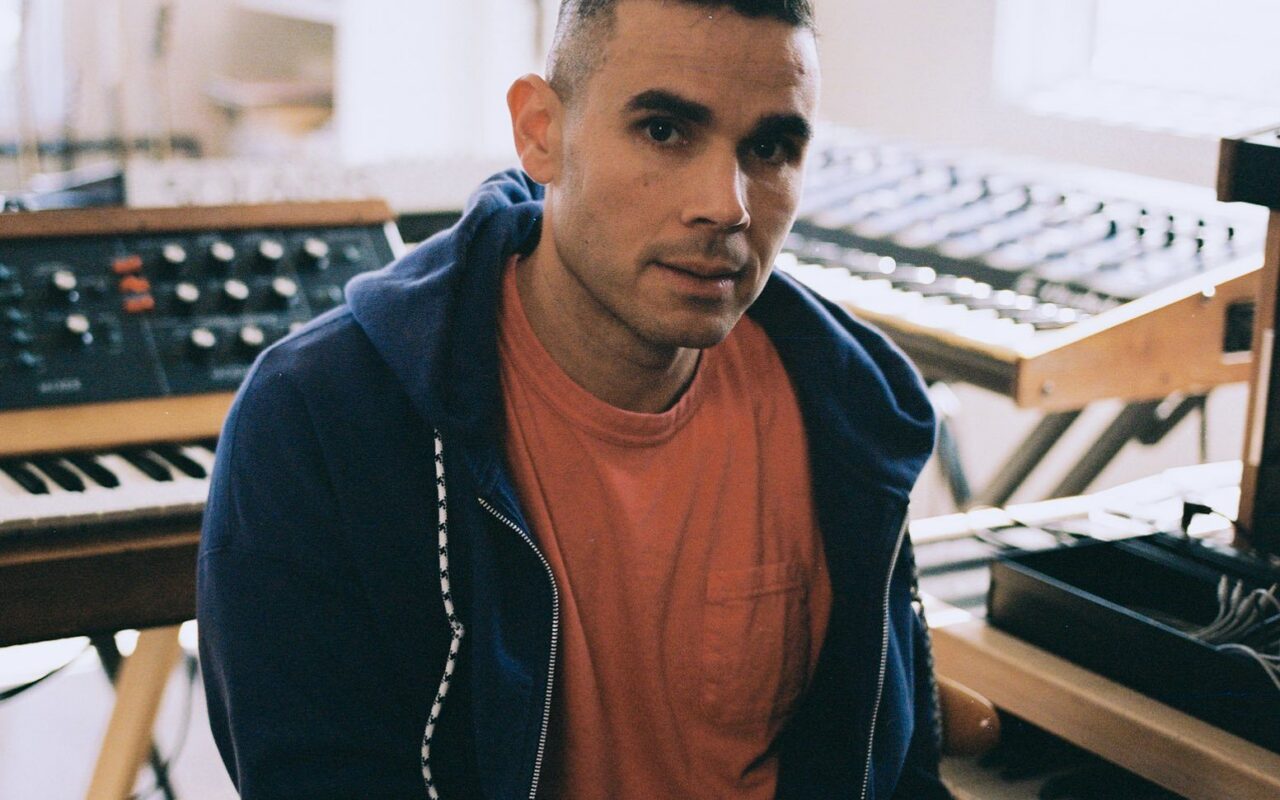
You’d be forgiven for thinking that the spotlight doesn’t sit comfortably with Rostam Batmanglij. As keyboardist and producer for Vampire Weekend, he cut a static figure on stage, statuesque behind his synth rig as frontman Ezra Koenig and bassist Chris Baio bounced around animatedly. His response to the band scoring back-to-back number one albums with 2010’s Contra followed by 2013’s Modern Vampires of the City – a record that took them to UK arenas and won a Grammy – was to walk away amicably at the end of its touring cycle.
That move heralded the opening of a new musical act – one that again had him in the background, rather than front and centre. Since leaving the group, he’s become best-known for his versatile and innovative production work, which has run across the genre spectrum from out-and-out pop (Charli xcx, Carly Rae Jepsen) to R&B (Frank Ocean, Solange) to the kind of indie fare he started out on; in 2016, he made a sensational collaborative record with The Walkmen’s Hamilton Leithauser.
The whole while, he notes on a video call from his home studio in Los Angeles, he has continued to chip away at solo work that takes him out of his comfort zone, both stylistically, and in terms of it requiring him to take centre stage for a change. “I think my first album was kind of rooted in classical songwriting,” he says of 2017’s kaleidoscopic Half-Light, “and on [2021’s second solo record] Changephobia, I was kind of playing around with jazz. I think I always start out with a bunch of lofty ideas. Only some of them stick around until the end.”
In that respect, his third album may be his most ambitious yet. American Stories is a gorgeous, lilting indie-pop record that is deeply personal in its sound, taking the soft hooks and melodies that have defined so much of his musical output and grounding them in instrumentation that reflects both sides of his heritage. Batmanglij was born in Washington DC in 1983, to Iranian parents who had fled Tehran after the revolution four years earlier.

“For as long as I’ve been making music, I’ve been interested in trying to mix American music with Persian music, just because I love them both deeply,” he says, grinning from behind a dark hood like a kind of benign, indie pop Sith Lord. “And that’s something that took a long time to come into focus. I’ve been making music as my profession since I was 22 years old, and I think I’d reached a point where I was asking myself, ‘What is the music that only I can make?’”
American Stories feels like a definitive answer to that question. He is reticent to talk about, or on behalf of, his parents, perhaps because they are both writers in their own right; he’ll only say that the record was “definitely, definitely inspired by music I grew up listening to”. Even then, he admits that the process of translating those influences into his own music was not something that came naturally to him. “It’s not music that I studied academically,” says Batmanglij, who is a graduate of Columbia University. “I studied western classical music. I feel like my love of guitar or piano aligns with my ability to play those instruments, but my love of Persian music is bigger than my capacity to reproduce it myself.”
For that reason, he drafted in a fellow Iranian-American, Amir Yaghmai, who plays in The Voidz with The Strokes frontman Julian Casablancas. Yaghmai studied under the legendary Persian musician Hossein Alizadeh at the California Institute of the Arts, and plays a raft of instruments native to Iran on the album, including both acoustic and electric saz, a kind of Middle Eastern guitar, as well as the yaylı tambur, which resembles the banjo.
The counterpoint to those sounds are ones that you would ordinarily associate with Americana; folk and country hang heavy over the album, and Batmanglij has dived deep into those instruments and their histories; he points out, for instance, that the pedal steel that illuminates “The Road to Death” and “Come Apart” actually originated in Hawaii, not the southern states of America it’s become so closely associated with.
What the record doesn’t do is investigate the political relationship between America and Iran too closely. It had already been written and recorded by the time the US and Israel launched their attack on Iran in late February, but Batmanglij points out that he would have been unlikely to address it directly anyway. “I don’t think I’m capable of writing lyrics that are reactive to current events,” he says. “I think that can be a treacherous path as an artist. I’m more interested in the longer-term project of saying things that have been on my mind for a number of years, rather than that morning’s headline.”

Regardless, it is difficult to shake the sense that Batmanglij speaks quietly to the state of the Middle East on American Stories; “Come Apart” makes apparent reference to the resilience of the Palestinian people, while “The Weight” has him affectionately offering solidarity to protesting students on American campuses. The election of Zohran Mamdani as Mayor of Batmanglij’s long-time hometown of New York City, meanwhile, was the moment the album’s themes seemed to crystallise for him.
“We’re in an era where people are trying to define what is and what isn’t American. And I think Zohran’s election contradicts that in a positive way. His politics are almost unique in America, in the sense that they are rooted in morality, and to me, that is a reclamation of what it means to be American.”
That’s something powerfully projected on the cover of American Stories, where the Stars and Stripes are depicted upside down, cast in soft yellow and orange tones, with Batmanglij’s name in Arabic. “I wanted to represent the contradictions inherent to the American project,” he explains. “We grow up being told that we live in the land of the free, but for who? Whose land are we on, and for who is it free?”
What the record warns against is division and cynicism, both in its blend of sonic cultures and in its thoughtful, optimistic lyricism. “I think if we give in to the idea that the American project is for other people and not for us, that incentivises disillusionment, and I think in turn, that further disconnects us from our obligations as citizens. What I wanted to say is that, regardless of background, the American project is one we should still feel invested in.”
The ultimate illustration of this, he reasons, is titling the album American Stories; he bristles at the suggestion it could be misinterpreted at a time when anti-US sentiment is running higher than it has in years. “You’re right – the word ‘American’ is pretty loaded right now,” he says. “I also think, simultaneously, that it’s important to investigate that. If people have a negative view of America, why is that? Is their own government contributing to the same actions that are reinforcing that view? If we zoom out, we can see there’s larger forces at work. You might find you’re more connected than you think to the same frameworks that you’d like to criticise from afar.”
‘American Stories’ is available now via Matsor Projects. Rostam plays London’s Village Underground on 8 September
المصدر: iNews