How Mumbai Was Planned Into Crowding
Not because Mumbaikars are too many
Ask anyone who lives in Mumbai how big their house is. Watch them hesitate.
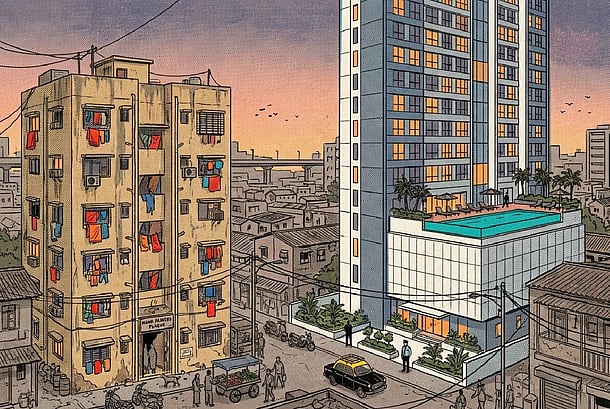
A Mumbai flat is small. Smaller than people from other Indian cities expect. Smaller than the same money buys anywhere else. The middle class lives in one-bedroom flats the size of a guest room in a Delhi house. The working class lives in chawls and shared single rooms. Roughly one in every two Mumbaikars lives in a slum.
Most people, including most Mumbaikars, treat this as a fact of geography. The city sits on a thin strip between the Arabian Sea and the Western Ghats; there is only so much land; what can you do. But this is the wrong diagnosis. Mumbai’s housing problem is not a shortage of land. It is a shortage of permission to build on the land it has.
For fifty years, the city has been forbidden by its own rulebook from using its plots the way almost every other major world city uses theirs. The crowded, expensive, half-informal Mumbai that millions of us know is what those rules built. The city is now, after decades of caution, building at speed; bridges over the sea, a metro underground, a million slum-dwellers being rehoused. Whether any of this corrects the old mistake, or sets it more firmly in concrete, is the question that hangs over the next decade.
The Seven Islands That Became a City
Mumbai began as seven swampy islands. That is genuinely all there was, a string of muddy hilltops poking out of the Arabian Sea between Colaba and Mahim. Over two centuries, the British filled the channels in, sometimes by dumping rubble, sometimes by building causeways. By the time the colonial state handed the city back to itself in 1947, the seven islands had become one. 69 sqkm. of municipal area, shaped like a kitchen knife pointing south into the sea.
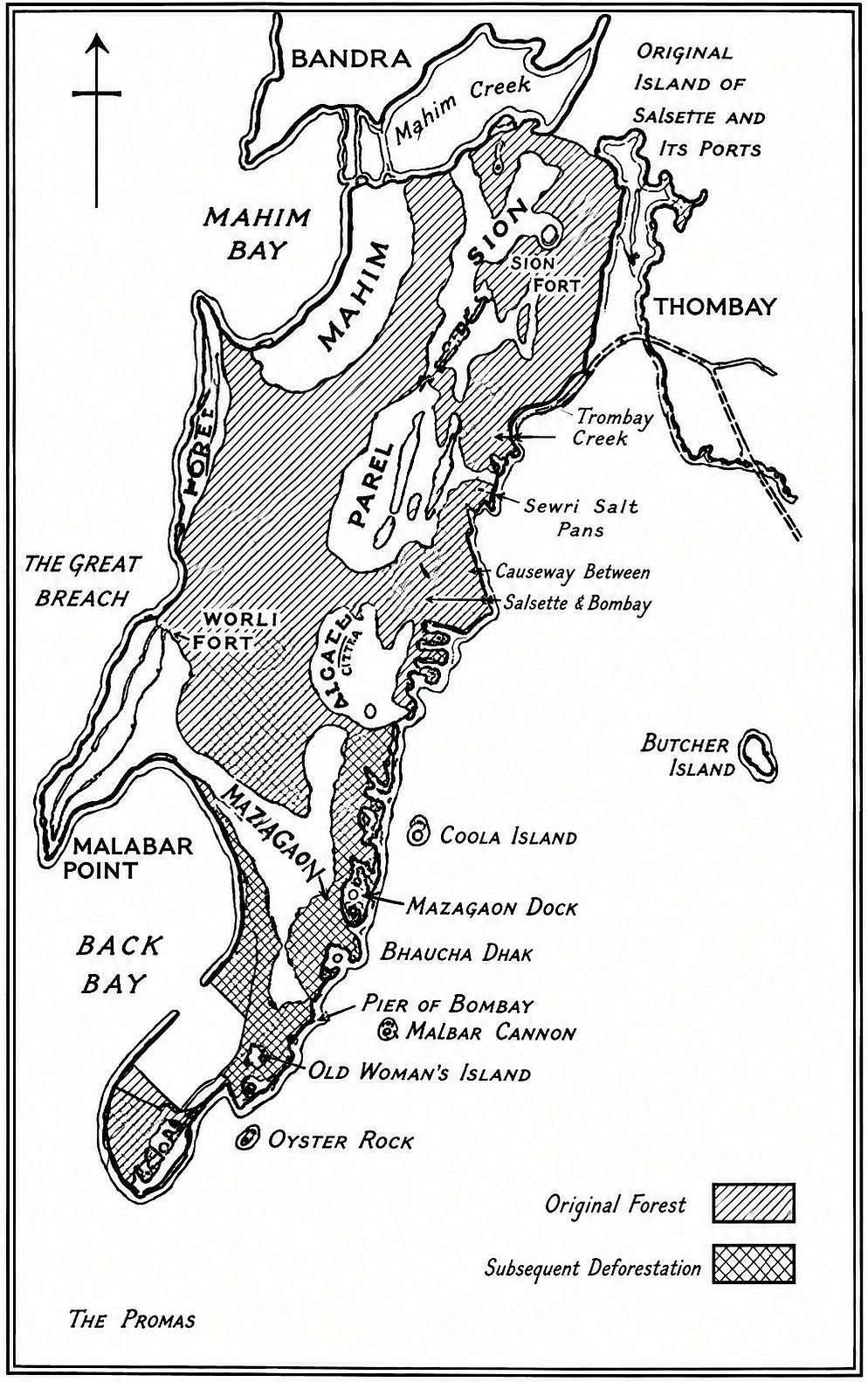
In 1957, ten years after independence, the city’s jurisdiction was extended northward. The new boundary captured 368 sqkm. of suburbs and salt pans, taking the total to 437. This is now Greater Mumbai, run by a single municipal corporation. The shape, however, never lost its old constraint. Mumbai is a long, narrow city with water on three sides. You cannot grow west, because there is the Arabian Sea. You cannot grow east, because there is Thane Creek and then the Western Ghats. You can only grow north, slowly, and so the city did.
In 1964, the city produced its first Development Plan. The document, sanctioned three years later, was a fine piece of post-independence ambition. Mumbai would become “a worthy capital of Maharashtra”, a “commercial and industrial centre”, and “above all a cherished home for its teeming millions”. It would have neighbourhoods with a sense of “healthy interdependence”. It would have a density of between 250 and 600 people per acre. It would have one acre of open space for every 1,000 people. It would decongest itself by discouraging the expansion of industry.
It did not become any of these things. Or rather, it became all of them in name and almost none of them in fact. The plan had no monitoring system, no way to check whether its objectives were being met. It assumed the planning authority could compulsorily acquire enormous tracts of private land. It assumed the central government would write large cheques. Neither assumption survived contact with reality.
To plan a city without an evaluation system is, in retrospect, an interesting kind of confidence. It is the planner’s equivalent of writing a novel and never reading it back.
The Rulebook That Held the City Down
To understand Mumbai’s crowding, you have to understand a single, dull abbreviation: FSI. Floor Space Index. If you have never heard of it, you have spent your life living inside its effects, like the air pressure you do not notice until it changes.
Here is what it means. If you own a piece of land of, say, a thousand square metres, and the FSI permitted on that land is 1, you can build buildings whose total floor area adds up to a 1000 sqm. One floor covering the whole plot. Two floors covering half. Four floors covering a quarter. The shape is up to you, the total is not. If the FSI is 3, you can build 3,000 sqm. If it is 10, then 10,000 sqm.
Until 1964, Mumbai did not really use FSI. Buildings were controlled by…
المصدر: Swarajya