What A NASA Satellite Saw Over Ayodhya, Srinagar, And Other Indian Cities That Statistics Did Not
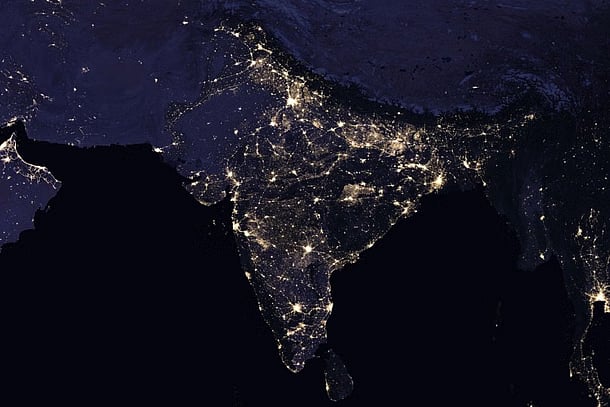
The data that nobody in India was reading
A NASA satellite has been photographing every Indian city after midnight since 2014. The pictures have sat on a public server the entire time.
This is about what one Pune developer has finally read in them, what those readings show about Indian cities that the government statistics do not, and the harder question they cannot yet answer.
On the night of 26 April 2025, ten days after the Pahalgam terror attack killed twenty-six tourists in Kashmir, the Suomi NPP satellite passed over Srinagar at approximately 1:54 in the morning local time. It photographed the city’s lights at the same brightness as the morning before, and almost the same brightness as the morning of 22 April when the attack happened.
Three hundred and twenty kilometres east, over Leh, the satellite recorded a city already dimming. By December, Srinagar’s lights would be down 0.6 per cent on the previous May. Leh’s would be down 9 per cent.
Both cities had received the same policy shock five years earlier — the revocation of Article 370 on 5 August 2019. Both received central money. Both, in the years since, had glowed steadily brighter from orbit. By 2025, Srinagar’s city centre was 88 per cent brighter than in 2014. Leh’s was 331 per cent brighter. Manali, included in the analysis as a control — similar geography, similar tourism dependence, no comparable policy shock — was 60 per cent brighter over the same period, steadily and unremarkably.
On the headline numbers, Leh was the runaway success. The trajectories after the April 2025 shock said something different. Srinagar’s growth was structural. Leh’s was not.
The data that says so was free, public, and almost nobody in India was reading it.
The signal
The instrument doing the looking is VIIRS — Visible Infrared Imaging Radiometer Suite — mounted on the Suomi NPP satellite jointly operated by NASA and NOAA. It passes overhead between approximately 1:30 and 2:30 in the morning local time, in India and everywhere else, and records how bright each 500-metre patch of ground is. NOAA bundles those observations into monthly composites and publishes them.
The current high-resolution series begins in 2014. Before VIIRS, the older DMSP-OLS sensor produced one image a year from 1992 to 2013; the upgrade turned an annual snapshot into a monthly one.
What VIIRS records is light. Not what is producing it. A village gets grid electricity for the first time. A military base goes up in a mountain valley and a few years later quietly winds down. A temple town is rebuilt from the inside. The sensor sees all of it. It does not know what it is seeing. It just records the brightness.
That indifference is the point. A government can publish whatever GDP figures it wants. It cannot make a city glow brighter from space.
The formal case for treating this signal as an economic proxy was established in 2012 by the economists Vernon Henderson, Adam Storeygard and David Weil. They found that changes in nighttime light correlate with real GDP changes at r = 0.88.
That r = 0.88 number deserves a moment of unpacking, because it will recur throughout. The correlation coefficient, r, is statisticians’ way of measuring how closely two things move together. It sits on a scale from -1 to +1.
– Zero means no relationship at all — knowing one tells you nothing about the other.
– A value of +1 means perfect lockstep: when one goes up, the other goes up by a proportional amount, every time.
– Anything above +0.7 is considered a strong positive relationship.
– Anything above +0.9 is essentially the two measurements telling the same story in different units.
Henderson’s 0.88 meant that nighttime lights and real GDP, across countries and decades, track each other closely enough that one can stand in for the other when the second is unavailable, delayed, or not entirely trusted. The numbers that show up later in this report— 0.917, 0.965, 0.977 — are stronger still.
Henderson and his colleagues also noticed something subtler. Lights respond to sustained changes in economic activity, not short-term fluctuations. Street lights and shop signs come on slowly as prosperity builds. They do not switch off when there is a bad quarter.
The World Bank now uses the signal to estimate output in countries with weak statistical systems. A small body of Indian research has extended the method to national, state and district level. The city level is where the work mostly has not been done — partly because reliable city-level GDP figures, the kind one would need to calibrate against, are scarce.
The accidental researcher
Abhijit Vaidya is a Pune-based technologist whose professional background is in building large-scale data systems. He came to this dataset by accident.
He was watching a podcast. The economist Ajay Shah was walking through work his team at xKDR had published on the Russia-Ukraine war. They had used nighttime lights — the same VIIRS composites, applied to the borders of a country being systematically destroyed — and found that Ukraine’s economic output had fallen to roughly half its pre-war level while Russia’s, despite sanctions, had barely moved.
What caught Vaidya’s attention was not the finding. It was what the…
المصدر: Swarajya