My 155mph train through Turkey cost just £24 – including tea, snacks and Wi-Fi
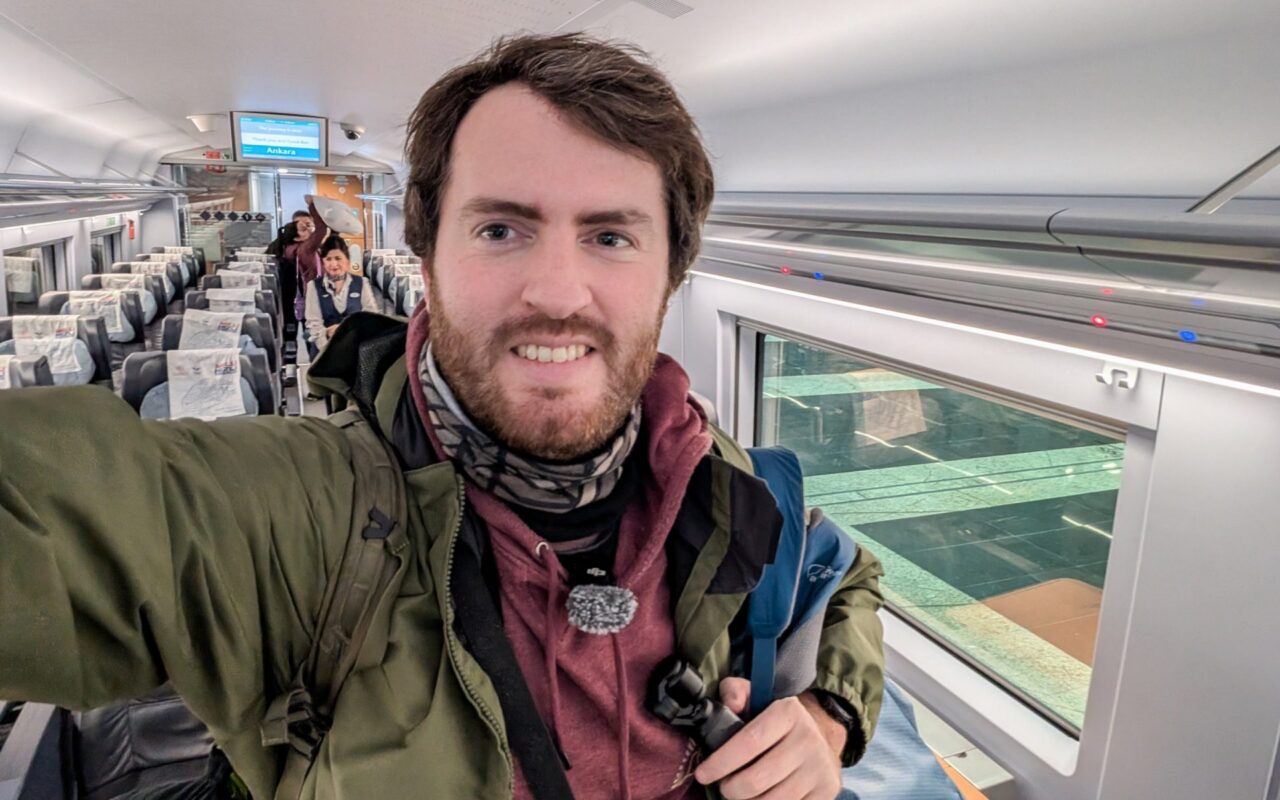
The 9.31am departed Istanbul’s Sögütlüçesme station precisely on time. And after traversing 576km (358 miles) in just under five hours, the YHT (high-speed train) arrived in Ankara only 10 minutes behind schedule.
Turkey’s high-speed rail network extends for 1,300km across Anatolia. It connects two of the country’s biggest cities as well as an increasing web of lesser-known towns across the Anatolian plateau where tourists seldom tread.
Economy-class tickets between Istanbul and Ankara cost as little as 930 lira (£15), making this a budget way to explore the Turkish heartlands. However, while these high-speed trains can reach speeds of 250kmh, they tend to average around 100kmh.
Trundling through Istanbul, the digital speedometers rarely broke 50kmh as we stopped at suburban stations. But spectacular views of the Sea of Marmara made up for our ponderous exit from the metropolis.

The journey isn’t much quicker than the bus, but it’s almost twice as fast as the sluggish, slow trains that once plied the same route. The bullet-like YHTs are a seamless and superior upgrade, too. There’s ample legroom. You can book and change tickets through the TCDD (Turkish trains) app. There’s a buffet carriage and the Wi-Fi actually works.
I purchased a business class seat for 1,395 lira (£24), which offered even more legroom than economy, as well as complimentary snacks and sandwiches and unlimited Turkish cay (tea).
Travellers have long romanticised Turkish rail travel. Istanbul was once the terminus of the Orient Express, but the city’s grand Ottoman-era terminals – Sirkeci on the European side, Haydarpasa on the Asian – closed years ago. Trains once departed Haydarpasa for Baghdad, but a fire in 2010 has left the station a forlorn hulk on the banks of the Bosphorus. Rail traditionalists might argue the romance of Turkish train travel died with Haydarpasa, but I would disagree.

Rather, it moved on with the first high-speed lines in 2009. The latest addition connects Ankara to Sivas further east. Lines are under construction to Izmir on the Mediterranean and Edirne on the Bulgarian border.
For visitors, the best route is the one I took to the capital, from where you can connect to slow trains trundling further east, or take the high-speed south to Konya, then back north to Istanbul.
The train accelerated as we left Istanbul. Then slowed as we followed winding gorges and rivers, inching upwards into the Anatolian plateau. On the flat plains towards Ankara, we finally let loose, maxing out at 250kmh. The city became Turkey’s capital in 1923 and uniform government ministries now surround the Old Town’s cobbled streets – but dig deeper and you’ll find a history stretching back to antiquity. One legend has King Midas, who turned everything he touched to gold, founding the city in the 8th century BC.

There are insights into Turkey’s past in the Museum of Anatolian Civilisations, next to Ankara Castle, where you’ll find 10,000-year-old stone tools. More recent history can be found at Anıtkabir, a grand mausoleum serving as the resting place of Mustafa Kemal Atatürk, who is revered as modern Turkey’s founder. I caught the slower Eastern Express towards the Armenian border. After a roundabout trip on slow trains and buses, a week or so later, I was back in Ankara, where I welcomed the YHT’s comforts on the 1 hour 45 minute journey south to Konya.
A sprawling city of two million people, Konya has long been popular with pilgrims from the mystical Sufi branch of Islam. The former capital of the Seljuks – Turkic nomads who conquered much of the Byzantine Empire in the 11th century – Konya is home to the tomb of Mevlana Rumi. The 13th-century Sufi poet’s ideas inspired the Mevlevi Order, whose followers are best known for their “whirling dervish” ceremonies. Konya’s Mevlana Cultural Centre hosts the real deal every Saturday night.
Nearby, the Çatalhöyük Unesco World Heritage Site offers a glimpse into the daily lives of Anatolia’s earliest human inhabitants, who constructed elaborate mud-brick houses here about 9,000 years ago.

On the edge of Konya, the village of Sille is hidden away in a gorge as dramatic as anywhere in Cappadocia and is home to one of the earliest centres of Christianity – the Byzantine Ayia Eleni Church. It is said to have been built by Helena, mother of Constantine the Great, who converted the Roman empire to Christianity.
From Konya, I completed the triangle, covering 700km back to Istanbul in five hours. The train reached top speeds as it charged across the vast, flat Anatolian steppe, just as the nomadic Seljuk Turks had centuries before on their horses. The perfect landscape for a high-speed journey.
How to get there
Wizz Air, Pegasus, Turkish Airlines and British Airways fly from the UK to Istanbul.
How to do it
YHT tickets can be booked through the TCDD app or in person at YHT stations in Turkey. Istanbul to Ankara costs 930 TL (£15), Ankara to Konya 430 TL and Konya to Istanbul 1355 TL, in economy.
Where to stay
Ankara Hotel, inside the high-speed train terminal, has doubles from £72. Sufi Homes in central Konya has doubles from £37, B&B.
المصدر: iNews