The bananas we all eat are at risk of extinction – inside the race to save them
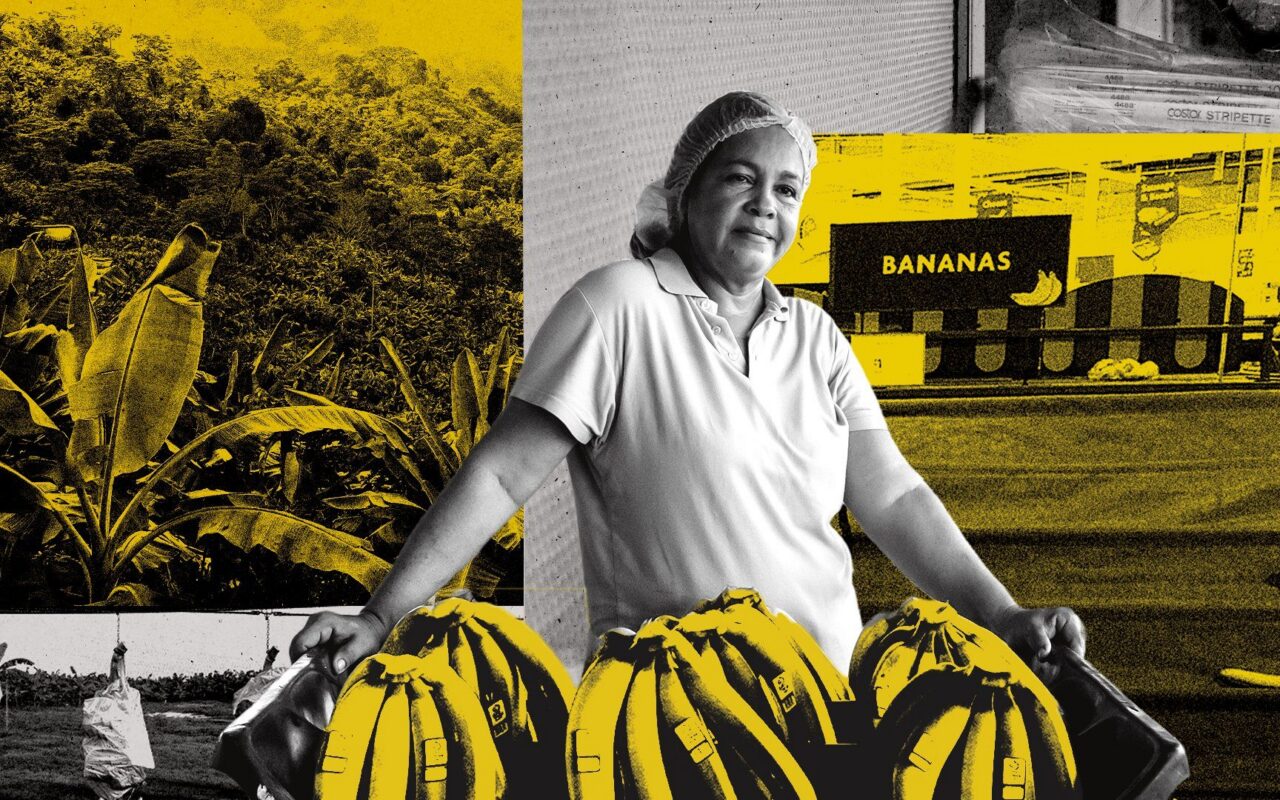
Across the world’s banana producing countries, there are two words which increasingly strike dread into the hearts of those responsible for producing a fruit, which supports 400m people, and is worth £700m in annual UK sales alone: Panama Disease.
The disease, also known as Tropical Race 4 or TR4, is a soil-borne fungus which is quietly laying waste to swathes of banana plantations across 20 countries from the Philippines to Peru, ruining the livelihoods of farmers and putting a question mark over the future of the globe’s most popular fruit.
According to the UN’s Food and Agriculture Organisation, TR4 is “one of the most aggressive and destructive fungi in the history of agriculture and the world’s greatest threat to banana production”.
One leading expert told The i Paper that for millions of small growers the threat from Panama Disease is “existential”.
For British consumers, the disease could soon diminish supplies of a fruit which last year saw annual domestic demand increase by 70m pieces to 4.5bn bananas – equivalent to 80 a year for each and every UK adult.
That is why, in a single brightly-lit sterile room on a research park in Norwich, a solution to this crisis is being crafted in the shape of thousands of tiny banana plantlets. Each of these seedlings has been gene-edited using state-of-the-art technology to make them resistant to the vagaries of TR4.
If all goes to plan, the world’s first super-bananas resistant to Panama Disease should be on global shop shelves by 2028, stamped – figuratively at least – with the words “Made in Norfolk”.
Exports trace back to a single plant
The work is being carried out by Tropic Biosciences, a small British biotechnology company.
After years of intricate laboratory work, the first crops of the TR4-resistant banana are currently being grown in field trials in key banana areas such as Central America and South East Asia.
The company told The i Paper that it was “pretty confident” it has perfected a banana that can beat the disease and, if this is proven in current trials, it expects to begin growing its innovation at commercial scale next year, ready for harvest in 2028.

Dr Philip Zegerman, the company’s director of technology and research, said: “At the end of the day, it’s not just the resistance that the growers need, it’s whether you also get the right fruit at the end and whether you can sell it.”
It is a challenge born from a uniquely delicate set of agricultural circumstances which make the banana not only the planet’s most popular and lucrative fruit – worth some $15.4bn (£11.5bn) in exports each year – but also one of the most vulnerable to devastating outbreaks of disease.
This is because almost every banana produced for commercial sale around the world is a clone of a single variety called Cavendish, named after William Cavendish, the 6th Duke of Devonshire, who had collected an example of the banana in the 1830s and cultivated it in his Derbyshire stately home, Chatsworth House.
Unusually vulnerable to disease
The Cavendish is what is known as a sterile triploid, meaning it produces no seeds and can only be propagated by selecting sprouts or suckers from an existing plant. Consequently, every Cavendish banana, responsible for about 99 per cent of commercial sales, is more or less genetically identical to another.
While this is great for achieving consistency in taste and size in a globalised industry, it is grim news indeed when it comes to vulnerability to disease. If a fungus or virus finds a way to lethally infect a single banana plant, it can in time devastate the entire global crop.

This is precisely what happened in the 1950s and 1960s, when a previous version of Panama Disease – Tropical Race 1 (TR1) – infected the then predominant banana variety, known as Gros Michel or Big Mike.
Within two decades, TR1 wiped out production of Gros Michel, by all accounts a sweeter and tastier banana than modern equivalents. It was only by dint of the fortuitous availability of the Cavendish variety, which had been replanted in the tropics and proved to be resistant to TR1, that commercial banana production did not grind to a halt.
Dr Zegerman said: “It was complete luck that we had the Cavendish waiting to take over. The problem is that the TR1 version of the fungus has since evolved into TR2, TR3 and now TR4. And TR4 is the one that has broken the resistance of the Cavendish banana. Only this time we don’t have a new ‘Cavendish’ to replace it.”
Pattern of devastation
The result is an increasing pattern of devastation across the world’s prime banana growing areas, in particular South and Central America, Asia and Africa.
TR4 works by blocking the banana plant’s ability to absorb nutrients, initially causing a tell-tale yellowing of leaves before then killing the plant entirely. Once present in the soil, it is more or less impossible to eradicate and will remain present for up to 30 years.

In Peru’s Piura region, the country’s biggest producer of organic bananas for export, TR4 has infected 45 per cent of farms and reduced yields by nearly half. It has permanently shut a tenth of plantations. It is a similar picture in the Philippines, where it has infected 15,000 hectares of plantations, and the fungus is now also present in Ecuador, the world’s biggest commercial banana producer.
Professor Altus Viljoen, a plant pathology expert at South Africa’s Stellenbosch University, told The i Paper that the disease is “disastrous”, in particular for smaller farmers with no means to shift production to different sites.
He said: “For small growers who cannot move to disease-free areas, the risk is indeed existential.”
It is against this backdrop that scientists from the Netherlands to Australia have been trying to develop a TR4-resistant version of the Cavendish, using techniques ranging from cross-breeding with wild banana varieties through to genetic modification. But to date, no commercially viable alternative has emerged.
Precision breeding plants
The researchers at Tropic believe they have now succeeded in solving this conundrum by harnessing the extraordinary powers of the emerging science of “precision breeding”.
A combination of such scientific know-how and a bespoke UK regulatory framework drawn up in the wake of Brexit, which is less restrictive than the regime in the European Union, has helped turn the UK into a world leader in this area. Another UK company last month unveiled a gene-edited wheat which produces markedly less of a cancer-chemical when bread is toasted.

In the case of TR4, the Norwich-based scientists used a genetic roadmap to identify the sub-set of genes, which make the Cavendish banana susceptible to the disease, and effectively switched off a range of relevant genes to see which of those leads to lasting resistance.
It takes two years alone for the gene-edited banana cells – grown in a sort of primordial gloop – to turn into the embryonic building blocks from which plants can be produced, and then a further eight months for the first leafy sprouts to emerge.
The Tropic growing room houses anywhere from 250,000 to 500,000 tiny banana plants at different stages of growth – all of which undergo testing to identify the one in 200 successfully carrying the new trait or traits. It is those plantlets which are then bred on for field testing and, ultimately, sale to commercial growers.
How this differs to controversial GM technique
The company is alive to the legacy of the genetic modification panic of the 1990s and the risk that consumers could react negatively to the idea of munching on a fruit whose internal genetic structure has been tweaked in a laboratory.
But it insists it is ready to meet such concerns. Not least, the company argues, because gene editing is merely an accelerated version of the natural process of cross-breeding in plants harnessed by humans for millennia.
Dr Zegerman said: “Genetic modification means bringing in DNA from a completely different organism. Gene editing is not the same. We are repeating the natural process of evolution by introducing changes that can occur by breeding.
“We’re not introducing any foreign DNA and that’s a fundamental difference.”
In March, Tropic secured an additional £80m in funding to roll out its plan for “mother plantations” across the world, which will act as nurseries for banana growers to buy its disease-resistant plantlets in return for a fee and an ongoing royalty for each crop. It seems unlikely that major banana growers facing the scourge of TR4 will baulk at such an arrangement if it allows them to protect revenues reaching into the billions.
Prof Viljoen said there were concerns that while “big banana” is set to benefit from the work of companies like Tropic, less affluent producers may struggle to access the latest innovations. He said: “Only about 15 per cent of all bananas grown globally are for export. The rest is for local production, food security and income generation, and is mainly produced by small or subsistence farmers.”
Tropic said the principle of helping growers large and small was central to its ethos. The company is in talks with at least one major charitable foundation about using its technology to improve crops relied on by subsistence farmers.
In the meantime, the company is unafraid of dreaming big. Ultimately, it would like to produce a single super-banana offering resistance to TR4 and other diseases alongside consumer or retailer-friendly traits like not going brown once cut.
Dr Zagerman said: “We want to replace all the bananas that are grown globally with elite, new varieties. Made in Norwich.”
المصدر: iNews